Mr. James Bow has authored a thoughtful reply to yesterday's post. I thought I'd take a few minutes to pen a few thoughts.
Firstly, I appreciate the time Mr. Bow devotes to writing about Toronto. Mr. Bow and I had an interesting back-and-forth last year on a blog devoted to boycotting St. Clair Avenue W. (The blog was the creation of a student from Edmonton - studying in K-W at the time - with very little experience actually living in Toronto.)
As with all debates, the product is less to persuade one party or other to change positions - and more to expose those on the sidelines to the facts and arguments that lend support the opposing sides. For those such as myself, Mr. Bow, students from Waterloo etc, participating in these debates is a hobby. The time allocated to debates is always limited - true.
However, for those who live and conduct business on St. Clair, the debate is more than academic. How things turn out could make or break the neighbourhoods. Will Hillcrest Village - as an example - continue to thrive as it has over the past number of years? Will anchor businesses in Corso Italiana be able to stay in the neighbourhood? No one knows. The St. Clair project is playing Russian roulette with the economic viability of a large chunk of central Toronto.
I agree that a rail-based system on St. Clair has a chance to be effective if LRT-type equipment were to be used. In fact, I - yes yours truly - prepared the first discounted cash flow analysis that compared the economics of replacing the streetcar equipment with light rail equipment vs. refurbishment of the streetcar equipment. It was I who gave this analysis to Councillor/Commissioner Joe Mihevc. (It was more that a little bit disconcerting that no-one at the Commission had carried out such an analyis before the St. Clair EA started.)
However, we need to be clear - leaving aside the fact that we don't even have specifications for LRT equipment that could run on the existing surface track network - having the proper equipment is only one of the preconditions for a succesful LRT.
There must be adequate space for stations - and stations must be reasonably well-spaced. At grade crossings at major intersections may also need to be eliminated in order to justify the capital expense of the equipment. (If you look at the successful LRT systems - Calgary and St. Louis come to mind - you'll see few (if any) - at-grade crossing at major intersections.)
I also believe that concrete-based roadbed should be kept to an absolute minimum so that the service disruption caused by the periodic and lengthy rebuilding of concrete-encased track is not such an issue. There's a reason railways use gravel ballast as roadbed!
In my view, it will be at least a decade before we might see new equipment in service. None of these other issues have even been looked at. Where does this leave the residents and businesses on St. Clair West?
I have checked out Mr. Munro's blog. He is duly critical of a number of things the TTC is doing. What confuses me is that:
1. He continues to support TTC Chair Howard Moscoe (psst - this is the man in charge! When we look for acountability - this is where the buck stops!)
2. He complains about service reliability- but doesn't really offer any suggestions for improving it.
Sunday, October 22, 2006


Saturday, October 21, 2006
Excellent reader input - Steetcar (non)-performance
I get a number of comments each week. All comments are welcome - although I won't post trashy comments.
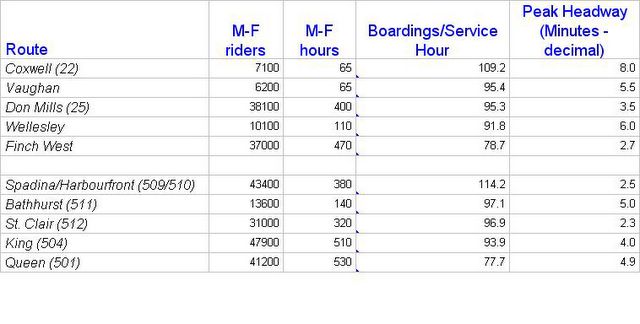
Earlier this week, a reader forwarded me an analysis he had done on TTC ridership by route. I've done some of my own analysis of overall ridership (a while ago now)- but this was new to me.
The analysis show the TTC top bus and streetcar routes by ridership per service hour. I've inserted a table provided to me below.
It's clear that steetcars are providing any extra capacity. This is no surprise to me - go back to some of the earlier posts on this blog. Here we have it from the TTC's own statistics.

Interesting reader input
PS - The reader was posting on streetcar afficionado Steve Munro's website - until Mr. Munro apparently curtailed the discussion. Again, no surprise to moi. I was in a debate with streetcar fan James Bow last year. After a number of posts back and forth, Mr. Bow ran for cover. Transitheads aren't used to be presented with facts and figures they don't like! Thank-you to Mr. Clawson - keep up the good work.
Earlier this week, a reader forwarded me an analysis he had done on TTC ridership by route. I've done some of my own analysis of overall ridership (a while ago now)- but this was new to me.
The analysis show the TTC top bus and streetcar routes by ridership per service hour. I've inserted a table provided to me below.
It's clear that steetcars are providing any extra capacity. This is no surprise to me - go back to some of the earlier posts on this blog. Here we have it from the TTC's own statistics.
Interesting reader input

PS - The reader was posting on streetcar afficionado Steve Munro's website - until Mr. Munro apparently curtailed the discussion. Again, no surprise to moi. I was in a debate with streetcar fan James Bow last year. After a number of posts back and forth, Mr. Bow ran for cover. Transitheads aren't used to be presented with facts and figures they don't like! Thank-you to Mr. Clawson - keep up the good work.
Sunday, October 15, 2006
More on transit - Montreal Transit Priority Network
The National Post is covering the transportation issue in the GTA. The series started on Saturday with a pretty good spread showing how the expressways become - well non-expressways. On Tuesday, Andrew Coyne will be covering the TTC. Well, let's hope it's better than the piece in The Star by Kenneth Kidd a month or so ago.
Kenneth Kidd's 10-point blueprint on transit was an unfortunate rehash of oft-recycled ideas and material. As usual, the vital ingredient of practicality was left out.
It would be great if Toronto could slowly eliminate parking spacing along canals - as has Amsterdam. Unfortunately, we don't have canals along many of our major thoroughfares. This aside from the fact that Amsterdam - a much smaller city that Toronto - is busy building a new subway and a new expressway. It would be great if Toronto could devote more road space to transit without impacting commercial traffic. Unfortunately, many of our arteries already suffer congestion from truck traffic alone.
For ideas on practical transit improvements, we are better to look to Montreal. For example, Montreal is implementing advanced transit priority on most major bus routes. For an investment of $35 million, it anticipates a 10-20% reduction of transit time on 230 km of bus routes. The TTC, in contrast, is spending almost $100 million to derive a similar benefit on a mere 6.5 km stretch of St. Clair West.
See the following from the STM website:
230 km of preferential measures for busesMontréal gives the green light to one of theworld's largest transit priority networks
Kenneth Kidd's 10-point blueprint on transit was an unfortunate rehash of oft-recycled ideas and material. As usual, the vital ingredient of practicality was left out.
It would be great if Toronto could slowly eliminate parking spacing along canals - as has Amsterdam. Unfortunately, we don't have canals along many of our major thoroughfares. This aside from the fact that Amsterdam - a much smaller city that Toronto - is busy building a new subway and a new expressway. It would be great if Toronto could devote more road space to transit without impacting commercial traffic. Unfortunately, many of our arteries already suffer congestion from truck traffic alone.
For ideas on practical transit improvements, we are better to look to Montreal. For example, Montreal is implementing advanced transit priority on most major bus routes. For an investment of $35 million, it anticipates a 10-20% reduction of transit time on 230 km of bus routes. The TTC, in contrast, is spending almost $100 million to derive a similar benefit on a mere 6.5 km stretch of St. Clair West.
See the following from the STM website:
230 km of preferential measures for busesMontréal gives the green light to one of theworld's largest transit priority networks
Saturday, October 14, 2006
Name that school board
Can you name this school board:
Clue #1:
has "a long-standing culture of approving new unfunded programs"
Clue #2:
In the face of declining enrolment, the board has cut classroom teachers, but maintained, if not increased, support staff levels in almost all areas
Clue #3:
is running up deficits largely because of "conscious board decisions" to spend money that it does not have
Well - if you haven't identified the suspect by now, you haven't been keeping up with local politics. The culprit is none other that the Toronto District School Board. Former Board supervisor Paul Christie was well-justified in asserting that the board is actually run by the janitors.
Clue #1:
has "a long-standing culture of approving new unfunded programs"
Clue #2:
In the face of declining enrolment, the board has cut classroom teachers, but maintained, if not increased, support staff levels in almost all areas
Clue #3:
is running up deficits largely because of "conscious board decisions" to spend money that it does not have
Well - if you haven't identified the suspect by now, you haven't been keeping up with local politics. The culprit is none other that the Toronto District School Board. Former Board supervisor Paul Christie was well-justified in asserting that the board is actually run by the janitors.
Tuesday, October 10, 2006
Now that's offensive - no it's pathetic
Someone has taken the time to create a weblog devoted to complaining about Globe & Mail columnist Margaret Wente. I won't grace this 'effort' with a link from my site. (Masochists may use web search tools to find it if they so choose.)
In the most recent post, the author complains about Ms. Wente's recent column on her experience using the TTC to get around for the better part of the week. The writer admits:
I only read the first third of the article (the only part outside the subscription firewall) but it's enough to get the gist.
This 'man' is devoting time to criticizing this writer - without even properly subscribing to be able to read her columns.
In the most recent post, the author complains about Ms. Wente's recent column on her experience using the TTC to get around for the better part of the week. The writer admits:
I only read the first third of the article (the only part outside the subscription firewall) but it's enough to get the gist.
This 'man' is devoting time to criticizing this writer - without even properly subscribing to be able to read her columns.
Monday, October 09, 2006
The row about the St. Clair ROW continues
The divisive row about the implementation of a streetcar right-of-way on St. Clair West is spilling into this years municipal elections. The Star's Royson James has an excellent right up in today's eddition:
Royson James - Oct 9th 2006
ROW proponent Councillor Joe Mihevc is facing two high profile challengers - former Toronto Mayor John Sewell, and former councillor John Adams.
James does a good job summing up the project:
Given the opportunity to create, almost from scratch, a spectacular street that redefines the boulevard into a pedestrian-friendly, transit-efficient and car-enabling street, the scheme has been compromised almost to the point of not satisfying anyone.
The best that can be said for streetcar travel is it will be reliable — not a small thing. But after tens of millions of dollars, travel along the route will only be marginally faster.
Cyclists and pedestrians don't get the sidewalk space and bike lanes that might have been anticipated. And the car loses a lane in many places.
With a price tag that will be about $100 million - even before the cost of refurbishing the existing streetcars - the average rider will save one minute of travel time. My belief is that the improved reliability will be less that advertised as well. Streetcars will still bunch up - the result of a natural stochastic process.
The poor payback of the project has been well known for a while. Numerous documents and reports have shown a 5-6 minute savings on a complete round trip is all that has been expected. Somehow this has come as a surprise to streetcar advocate Steve Munro. Writes Munro:
Er, didn’t this used to be a one-way saving? Did the writer get it wrong, or has the TTC backed down even further on the benefit of the exclusive lanes? Let’s be generous and say it’s one-way. This represents roughly a 15% improvement in running time. What does this do to the frequency of service (assuming we keep the same number of cars)?
Sorry Steve - check the original documents. [For example - TTC Report "Streetcar Rapid Transit on St. Clair" - December 9th 2002]
Royson James - Oct 9th 2006
ROW proponent Councillor Joe Mihevc is facing two high profile challengers - former Toronto Mayor John Sewell, and former councillor John Adams.
James does a good job summing up the project:
Given the opportunity to create, almost from scratch, a spectacular street that redefines the boulevard into a pedestrian-friendly, transit-efficient and car-enabling street, the scheme has been compromised almost to the point of not satisfying anyone.
The best that can be said for streetcar travel is it will be reliable — not a small thing. But after tens of millions of dollars, travel along the route will only be marginally faster.
Cyclists and pedestrians don't get the sidewalk space and bike lanes that might have been anticipated. And the car loses a lane in many places.
With a price tag that will be about $100 million - even before the cost of refurbishing the existing streetcars - the average rider will save one minute of travel time. My belief is that the improved reliability will be less that advertised as well. Streetcars will still bunch up - the result of a natural stochastic process.
The poor payback of the project has been well known for a while. Numerous documents and reports have shown a 5-6 minute savings on a complete round trip is all that has been expected. Somehow this has come as a surprise to streetcar advocate Steve Munro. Writes Munro:
Er, didn’t this used to be a one-way saving? Did the writer get it wrong, or has the TTC backed down even further on the benefit of the exclusive lanes? Let’s be generous and say it’s one-way. This represents roughly a 15% improvement in running time. What does this do to the frequency of service (assuming we keep the same number of cars)?
Sorry Steve - check the original documents. [For example - TTC Report "Streetcar Rapid Transit on St. Clair" - December 9th 2002]
Sunday, October 01, 2006
The Third Man
Actually, the third candidate of note has entered the mayoral race. His name - Stephen LeDrew - erstwhile chief cook and bottle washer in the Liberal Party of Canada.
The real question is 'Why is this man running?". Yes - the city is being run into the ground by the current mayor - but what could Mr. LeDrew do about it?
I'm going to play wait and see. However, seeing as this man was recently forced into bankrupty over back taxes, this campaign is not going very far very fast. This is the one time I'd actually have to agree with some of Mayor Miller's press release - i.e. John Barber's column in the Globe and Mail.
The real question is 'Why is this man running?". Yes - the city is being run into the ground by the current mayor - but what could Mr. LeDrew do about it?
I'm going to play wait and see. However, seeing as this man was recently forced into bankrupty over back taxes, this campaign is not going very far very fast. This is the one time I'd actually have to agree with some of Mayor Miller's press release - i.e. John Barber's column in the Globe and Mail.
Saturday, September 23, 2006
Let the silly season begin
Not - not Autumn per se - but municipal election season in Toronto.
Mayor Miller has just bought us into a landfill near London. Londoners aren't exactly "willing hosts" for this. I seem to remember that this was the reason that council's leftists chose Michigan over the Adam's Mine. What a bunch of pelletized sewage effluent! We don't know the price, terms etc. Miller just wants us the trust him. We'll only find out after the election.
Jane Pitfield - Miller's main challenger in the race - is making as issue of this. Rightly so in my book.
Of course, trained NDP seal John Barber (Globe & Mail) is bounding to the Mayor's defence.
Of course, it's always silly season in "Barberland". It's no surprise that this reporter supports Toronto Mayor David Miller's plan for the acquisition of the Green Lane landfill. Barber's views unerringly align with Miller and his cadre of left-leaning councillors. His columns save me from having to read the contemporaneous writings of my local councillors in the neighbourhood flyers. I'm often left wondering who gets to write the first draft.
Mayor Miller has just bought us into a landfill near London. Londoners aren't exactly "willing hosts" for this. I seem to remember that this was the reason that council's leftists chose Michigan over the Adam's Mine. What a bunch of pelletized sewage effluent! We don't know the price, terms etc. Miller just wants us the trust him. We'll only find out after the election.
Jane Pitfield - Miller's main challenger in the race - is making as issue of this. Rightly so in my book.
Of course, trained NDP seal John Barber (Globe & Mail) is bounding to the Mayor's defence.
Of course, it's always silly season in "Barberland". It's no surprise that this reporter supports Toronto Mayor David Miller's plan for the acquisition of the Green Lane landfill. Barber's views unerringly align with Miller and his cadre of left-leaning councillors. His columns save me from having to read the contemporaneous writings of my local councillors in the neighbourhood flyers. I'm often left wondering who gets to write the first draft.
Saturday, September 16, 2006
The poor Pope
One has to feel sorry for the Pope. When a man devotes himself to his faith and church, there's little time, perhaps, to become an expert in politics. I guess some Muslims have taken offense to some of the Pontiffs statement.
The Pope should have know that anything he might say about Muslims, Islam, Muhammad would have raised a negative reaction. Today's Muslims seem all too ready to take offense. Many have raised being thin-skinned to an art form.
The Pope should have know that anything he might say about Muslims, Islam, Muhammad would have raised a negative reaction. Today's Muslims seem all too ready to take offense. Many have raised being thin-skinned to an art form.
Thursday, September 14, 2006
Ken Dryden the dreamer
Ken Dryden is one of Cornell's (my alma mater) most famous athletes. No doubt, the man once had some level of intellect - or he wouldn't have graduated. However, perhaps as a result of a puck in the face at some point in his NHL career, he appears to have lost it. There is no other explanation for the continuous stream of babble forthcoming from this candidate for the Lberal leadership.
This is a man who played for perhaps the greatest collegiate hockey coach (Ned Harkness) and the greatest NHL coach (Scotty Bowman). At Cornell and with the Canadiens, Dryden played to win and his teams did so. This is Dryden remembering Harkness:
"At Cornell we played only twenty-nine games a year, as opposed to over a hundred with the Canadiens...Ned knew just how to maximize the importance of each one. Not only was every game vital and critical, so was every practice, every period, every shift. Every player soon understood this and was motivated by the realization."
So why on earth would Dryden join a party where nothing really matters except appearances: where signing Kyoto is important - but results are not; a party that spends on national unity in Quebec, but has no measures of how the money is spent; a party that sends money willy-nilly to the provinces and calls it a child care program; a party that creates a gun registry, without any results.
To continually implement policies that don't work is a policy of continually losing. For the fed-Fibs, all that ever matters is winning power. I wouldn't have thought that this was the right place for someone who has been used to really winning. hmm - perhaps it was those years spent with the Maple Leafs.
This is a man who played for perhaps the greatest collegiate hockey coach (Ned Harkness) and the greatest NHL coach (Scotty Bowman). At Cornell and with the Canadiens, Dryden played to win and his teams did so. This is Dryden remembering Harkness:
"At Cornell we played only twenty-nine games a year, as opposed to over a hundred with the Canadiens...Ned knew just how to maximize the importance of each one. Not only was every game vital and critical, so was every practice, every period, every shift. Every player soon understood this and was motivated by the realization."
So why on earth would Dryden join a party where nothing really matters except appearances: where signing Kyoto is important - but results are not; a party that spends on national unity in Quebec, but has no measures of how the money is spent; a party that sends money willy-nilly to the provinces and calls it a child care program; a party that creates a gun registry, without any results.
To continually implement policies that don't work is a policy of continually losing. For the fed-Fibs, all that ever matters is winning power. I wouldn't have thought that this was the right place for someone who has been used to really winning. hmm - perhaps it was those years spent with the Maple Leafs.
Saturday, September 09, 2006
Now there's an example of how things should GO!
GO Transit's Board are to be commended on taking swift action to stem absenteeism problems - which are especially impacting Friday service:
Toronto Star - September 9th 2006
Unionized crews contracted by Go from CN have been leaving passengers in the lurch to enjoy long weekends.
Per GO Transit Board member Bill Fisch:
"We'll solve it.... We are going out to the tender process to see if others will be interested in (running GO trains). That will hold everyone's feet to the fire to provide a better service for us. I don't think people will stand for bad service."
It's too bad that the people running (yes I realise - a rather loose use of the term) the Toronto Transit Commission, don't have the same passion for providing service. The TTC has terrible absenteeism problems. Did Howard Moscoe and his fellow traveller commissioners try to address this in the most recent contract? Don't be silly, they were too busy telegraphing the fat juicy raise they were all too eager to grant the union.
Self-styled transit advocates such as Steve Munroe hand ring over the TTC service problems. However, they seem to dismiss any notion that the Commission push for increased performance. In my view, we need true passenger advocates - such as Mr. Fisch instead of the likes of Moscoe and Munroe.
Toronto Star - September 9th 2006
Unionized crews contracted by Go from CN have been leaving passengers in the lurch to enjoy long weekends.
Per GO Transit Board member Bill Fisch:
"We'll solve it.... We are going out to the tender process to see if others will be interested in (running GO trains). That will hold everyone's feet to the fire to provide a better service for us. I don't think people will stand for bad service."
It's too bad that the people running (yes I realise - a rather loose use of the term) the Toronto Transit Commission, don't have the same passion for providing service. The TTC has terrible absenteeism problems. Did Howard Moscoe and his fellow traveller commissioners try to address this in the most recent contract? Don't be silly, they were too busy telegraphing the fat juicy raise they were all too eager to grant the union.
Self-styled transit advocates such as Steve Munroe hand ring over the TTC service problems. However, they seem to dismiss any notion that the Commission push for increased performance. In my view, we need true passenger advocates - such as Mr. Fisch instead of the likes of Moscoe and Munroe.
Monday, September 04, 2006
A different view of the Canadian International Airshow
With Ernesto and the rain finally clearing, I biked out onto the Leslie St. Spit this afternoon. I had two purposes: to exercise (getting a break from step machines and weights), and to catch some of the Airshow.
Of course, being out on the Spit is not the same as being front row center down at the Ex. However, the view - especially from the lighthouse 'hill' has some advantages:
1. Fewer crowds - no parking or streetcar hassles.
2. No ticket - if it's raining or the jets can't fly because of the ceiling, you don't have to go.
3. Different views - the jets will circle around to the East in advance of theri actual performance. Many of the high performance jets actually pass very close to the end of the point as they approach the show.
Today, I was a bit late. I could see the very end of the B-1B's peformance as it ascended into teh clouds and away. Someone mentioned that this was an F-14 - because of the intense noise. Well - no, there isn't anything I've heard that's quite as loud as the B-1B. (I once stopped at a rest stop in South Dakota near Ellswoth AFB. The B-1s were on a circle that went right over the MacDonalds. I've never heard anything like it. )
After that, followed the F15, CF-18, F-16 and various more specialized planes - not to mention the small aerobatic planes. (I'd recommend going to the Ex to see these.)
I cycled around until about 4:00 pm. I guess the Snowbirds were a little later - but I had other things to attend to. (Hmm - and there are no concessions out on the Spit.)
Of course, being out on the Spit is not the same as being front row center down at the Ex. However, the view - especially from the lighthouse 'hill' has some advantages:
1. Fewer crowds - no parking or streetcar hassles.
2. No ticket - if it's raining or the jets can't fly because of the ceiling, you don't have to go.
3. Different views - the jets will circle around to the East in advance of theri actual performance. Many of the high performance jets actually pass very close to the end of the point as they approach the show.
Today, I was a bit late. I could see the very end of the B-1B's peformance as it ascended into teh clouds and away. Someone mentioned that this was an F-14 - because of the intense noise. Well - no, there isn't anything I've heard that's quite as loud as the B-1B. (I once stopped at a rest stop in South Dakota near Ellswoth AFB. The B-1s were on a circle that went right over the MacDonalds. I've never heard anything like it. )
After that, followed the F15, CF-18, F-16 and various more specialized planes - not to mention the small aerobatic planes. (I'd recommend going to the Ex to see these.)
I cycled around until about 4:00 pm. I guess the Snowbirds were a little later - but I had other things to attend to. (Hmm - and there are no concessions out on the Spit.)
Sunday, September 03, 2006
L'Affaire Bombardier
The TTC (i.e. the nine city councilors who sit on the Commission) have voted to approve the award of a contract for replacement subway cars to Bombardier - without having allowed competitors to make proposals. Of course, the likes of TTC chair Howard Moscoe (a.k.a. resident windbag) and Moscoe-lite Adam Giambrone are spouting off about what a great deal it is.
Yes - they did get some outside consultants to bless the deal. This is no surprise. Consultants know what side the bread is buttered on. They would never in a million years concluded that the decision needed to be reconsidered - because they would certainly never get any work at The City of Toronto again. As one of my classmates put it in B-School : "Give me Lotus 123 and a few hours and I can make any company look good" - well the same is true for anything transit related.
Giambrone - who was caught getting election help from Bombardier - is brazen enough to defend the decision in today's Toronto Star (Giambrone - OP ED - Sept 2 2006). Write Giambrone:
Justice Denise Bellamy, in her report on the city's computer purchasing scandal, points out that "if a government's policy gives priority to the local economy, a large procurement decision might properly favour a company that is a bit more expensive but local, so that tax dollars stimulate the local economy."
Firstly, Thunder Bay isn't local. Obviously, Thunder Bay didn't think of Mississauga as local when it purchased low-floor buses from a Quebec company - despite the fact that there is a bus supplier in Ontario. Furthermore, there is no way to tell if a local supplier is 'a bit more' or 'a lot more' expensive without actually allowing different suppliers to quote.
Giambrone goes on:
Transit agencies do this because transit vehicle purchases are incredibly complex and customized. It's best to work with a manufacturer to achieve the product you want more quickly than you otherwise would......We already have Bombardier cars, and they've served us well for many decades. There's value in continuing to use a tested, trusted product. And in this case, that product is a good value at a good price for the residents and transit riders of Toronto.
However, the Thunder Bay plant has a poor record of being able to deliver. Montreal's MR-63 cars - made by Vickers - have far outlasted Thunder Bay sourced subway cars. Bombardier's Thunder Bay plant is also the source of the TTC's disastrous streetcar fleet.
Yes - they did get some outside consultants to bless the deal. This is no surprise. Consultants know what side the bread is buttered on. They would never in a million years concluded that the decision needed to be reconsidered - because they would certainly never get any work at The City of Toronto again. As one of my classmates put it in B-School : "Give me Lotus 123 and a few hours and I can make any company look good" - well the same is true for anything transit related.
Giambrone - who was caught getting election help from Bombardier - is brazen enough to defend the decision in today's Toronto Star (Giambrone - OP ED - Sept 2 2006). Write Giambrone:
Justice Denise Bellamy, in her report on the city's computer purchasing scandal, points out that "if a government's policy gives priority to the local economy, a large procurement decision might properly favour a company that is a bit more expensive but local, so that tax dollars stimulate the local economy."
Firstly, Thunder Bay isn't local. Obviously, Thunder Bay didn't think of Mississauga as local when it purchased low-floor buses from a Quebec company - despite the fact that there is a bus supplier in Ontario. Furthermore, there is no way to tell if a local supplier is 'a bit more' or 'a lot more' expensive without actually allowing different suppliers to quote.
Giambrone goes on:
Transit agencies do this because transit vehicle purchases are incredibly complex and customized. It's best to work with a manufacturer to achieve the product you want more quickly than you otherwise would......We already have Bombardier cars, and they've served us well for many decades. There's value in continuing to use a tested, trusted product. And in this case, that product is a good value at a good price for the residents and transit riders of Toronto.
However, the Thunder Bay plant has a poor record of being able to deliver. Montreal's MR-63 cars - made by Vickers - have far outlasted Thunder Bay sourced subway cars. Bombardier's Thunder Bay plant is also the source of the TTC's disastrous streetcar fleet.
Friday, September 01, 2006
Much airport silliness
Porter Airlines - the startup that will be flying spanking new Q-400 turbo-props out of the Toronto Island Airport - took delivery of the first such aircraft this week. This of course meant a rekindling of howls from the L.F. (that's lunatic fringe or left field - either interpretation will do.)
I actually think more Torontonians are catching on about our Miller-lite mayor. There were three letters in The Star supporing the new service. Today, there was a particularly vehement letter which took issue with the mayor and minions using waterfront examples such as Melbourne, Barcelona and Chicago.
It's telling the that lists of shining examples of waterfronts invariably do not include Canada's own Vancouver. Could this be because Vancouver has a busy commerical airport nestled in Coal Harbour - snug between Stanley Park and downtown? The airport, BC's fifth busiest, uses a control tower on the 29th floor of a downtown office building. Planes frequently (or usually) approach and depart over Stanley Park.
The Coal Harbour facility hasn't prevented Vancouver from having a beautiful waterfront. It didn't prevent it from attracting EXPO or the Winter Olympics. Neither did it prevent Travel & Leasure Magazine from naming it among the top 10 tourist destinations.
Perhaps we should trade David Miller and some minor league councillors to Vancouver for an airport. Oh - we already have an airport. Well, let's just trade them for some cedar shingles.
I actually think more Torontonians are catching on about our Miller-lite mayor. There were three letters in The Star supporing the new service. Today, there was a particularly vehement letter which took issue with the mayor and minions using waterfront examples such as Melbourne, Barcelona and Chicago.
It's telling the that lists of shining examples of waterfronts invariably do not include Canada's own Vancouver. Could this be because Vancouver has a busy commerical airport nestled in Coal Harbour - snug between Stanley Park and downtown? The airport, BC's fifth busiest, uses a control tower on the 29th floor of a downtown office building. Planes frequently (or usually) approach and depart over Stanley Park.
The Coal Harbour facility hasn't prevented Vancouver from having a beautiful waterfront. It didn't prevent it from attracting EXPO or the Winter Olympics. Neither did it prevent Travel & Leasure Magazine from naming it among the top 10 tourist destinations.
Perhaps we should trade David Miller and some minor league councillors to Vancouver for an airport. Oh - we already have an airport. Well, let's just trade them for some cedar shingles.
Sunday, August 27, 2006
Summer draws to a close
I've had a busy summer - albeit that little of it has been devoted to writing. With the upcoming municipal elections, I plan to be writing more in this space.
Today, I thought I'd pen a few thoughts on the happenings in the larger world. The biggest story of the past few months has been the 'war' between Israel and the terrorist group Hezbollah that has ensconced itself in southern Lebanon. Here are some of my observations:
Disgust - Aside from the initiation of hostilities by Hezbollah, the most disgusting thing has been the attempt by the Liberals to make a domestic issue out of this. To try to score domestic political points from a conflict is unconscionable - which meant various prominent figures in the federal Liberal party ploughed right in and did so.
The claim that supporting Israel's right to defend itself was spoiling Canada's good name as an 'honest broker' is completely spurious. Canada is no broker at all - we couldn't even get a modicum of justice for the Canadian journalist who perished in police custody in Iran. I'm sure the terror groups are cackling quietly at these useful Liberal idiots.
Amazement - I ventured into a few online discussions on the Globe and Mail's board (i.e. the one that the editor enable son some stories and columns.) I was amazed at the ignorance and vitriol by some posters against Israel - akin to what reared its ugly head in the Liberal Party a week or so ago. One poster actually claimed that Syria hadn't attacked anyone in 500 years. I guess her fogot about 1948, 1956 etc. when Syria attacked Israel. hmm - I guess like Syria, he didn't recognize Israel.
Winners and Losers - Many of the pro-Hiz posters are ready to pronounce that Israel 'lost' the war. My take is that there was no winner and loser in the immediate conflict. Too much is made of the fact that Israel didn't finish off Hezbollah. Perhaps they would have been better off following the 1982 strategy of simply occupying South Lebanon - but perhaps not.
Some commentators were cheering the Israeli losses in the lost offensive. In fact, the casualties were low considering the risky natire of the operations: commando raids and infantry advance my helicopter.
Israel won the following:
1. Managed to get a larger multinational force (at least promised) in South Lebanon
2. Destroyed quite a good proportion of Hezbollah's existing armaments.
3. Showed that it was prepared to retaliate against agressors with force. In fact, the retaliation was certainly in proper proportion to the threat - seeing that Iran has been threatening to incinerate the place.
4. Managed to get the Lebanese to move troops to the south - which apparently hasn't been as difficult as they protested at the start of the conflict. (The Lebanese appear to have the same disease as many in the Arab world - that being rampant duplicity.)
Israel lost the following:
1. The PR war - but it would have probably lost this no matter what.
Today, I thought I'd pen a few thoughts on the happenings in the larger world. The biggest story of the past few months has been the 'war' between Israel and the terrorist group Hezbollah that has ensconced itself in southern Lebanon. Here are some of my observations:
Disgust - Aside from the initiation of hostilities by Hezbollah, the most disgusting thing has been the attempt by the Liberals to make a domestic issue out of this. To try to score domestic political points from a conflict is unconscionable - which meant various prominent figures in the federal Liberal party ploughed right in and did so.
The claim that supporting Israel's right to defend itself was spoiling Canada's good name as an 'honest broker' is completely spurious. Canada is no broker at all - we couldn't even get a modicum of justice for the Canadian journalist who perished in police custody in Iran. I'm sure the terror groups are cackling quietly at these useful Liberal idiots.
Amazement - I ventured into a few online discussions on the Globe and Mail's board (i.e. the one that the editor enable son some stories and columns.) I was amazed at the ignorance and vitriol by some posters against Israel - akin to what reared its ugly head in the Liberal Party a week or so ago. One poster actually claimed that Syria hadn't attacked anyone in 500 years. I guess her fogot about 1948, 1956 etc. when Syria attacked Israel. hmm - I guess like Syria, he didn't recognize Israel.
Winners and Losers - Many of the pro-Hiz posters are ready to pronounce that Israel 'lost' the war. My take is that there was no winner and loser in the immediate conflict. Too much is made of the fact that Israel didn't finish off Hezbollah. Perhaps they would have been better off following the 1982 strategy of simply occupying South Lebanon - but perhaps not.
Some commentators were cheering the Israeli losses in the lost offensive. In fact, the casualties were low considering the risky natire of the operations: commando raids and infantry advance my helicopter.
Israel won the following:
1. Managed to get a larger multinational force (at least promised) in South Lebanon
2. Destroyed quite a good proportion of Hezbollah's existing armaments.
3. Showed that it was prepared to retaliate against agressors with force. In fact, the retaliation was certainly in proper proportion to the threat - seeing that Iran has been threatening to incinerate the place.
4. Managed to get the Lebanese to move troops to the south - which apparently hasn't been as difficult as they protested at the start of the conflict. (The Lebanese appear to have the same disease as many in the Arab world - that being rampant duplicity.)
Israel lost the following:
1. The PR war - but it would have probably lost this no matter what.
Thursday, August 03, 2006
The Liberals - the Seinfeld government
In the latest news on the the fallout from the Chretien-Martin Regime, we find out that the plan an legislation that was supposed to help supply poor countries with better access to AIDs and other medicines has in fact delivered ZERO drugs.
The Toronto Star - Aug 3 2006 - Canada Breaks AIDs Pledge
This should hardly be surprising - given that the Liberals:
1. Signed up for Kyoto - but made no progress in meeting the targets
2. Created the sponsorship program - which seems to have produced nothing but a scandal
3. Apparently (per Bill Graham in The Globe and Mail yesterday) had a policy of buidling bridging between adversaries in the Middle East. No such Canadian built bridges seem to exist.
It's clear that the Liberals think of Acts of Parliament as play acting. I guess someone forgot to mention that they are supposed to be real. The Liberal emporers had no clothes - and it wasn't a pretty sight. The Liberals - a government about nothing!
The Toronto Star - Aug 3 2006 - Canada Breaks AIDs Pledge
This should hardly be surprising - given that the Liberals:
1. Signed up for Kyoto - but made no progress in meeting the targets
2. Created the sponsorship program - which seems to have produced nothing but a scandal
3. Apparently (per Bill Graham in The Globe and Mail yesterday) had a policy of buidling bridging between adversaries in the Middle East. No such Canadian built bridges seem to exist.
It's clear that the Liberals think of Acts of Parliament as play acting. I guess someone forgot to mention that they are supposed to be real. The Liberal emporers had no clothes - and it wasn't a pretty sight. The Liberals - a government about nothing!
A review of TTC streetcar air-conditioning
I must admit that Steve Munro is a truly dedicated transit enthusiast: to wait around for a specific streetcar vehcile to come around. In this case, this is the TTC 1st air-conditioned streetcar - recently returned from Howard Moscoe's buddies at Bombardier with a new box on top.
Well, Munro is honest enough to point out some significant problems with the experiment - unlike other transit boosters who'll sing the TTC's praises not matter how badly it performs.
Concludes Munro:
If this is an example of what we’ll get on new or rebuilt streetcars, it’s time to go back to the drawing board.
Perhaps the TTC will go back to the drawing board - but I'm guessing that they wont. They have the habit of calling a failure a success: streetcars in general, and the Spadina "LRT" specifically. Moscoe and his TTC will do anything to avoid getting political egg on their faces - the riders be damned.
Well, Munro is honest enough to point out some significant problems with the experiment - unlike other transit boosters who'll sing the TTC's praises not matter how badly it performs.
Concludes Munro:
If this is an example of what we’ll get on new or rebuilt streetcars, it’s time to go back to the drawing board.
Perhaps the TTC will go back to the drawing board - but I'm guessing that they wont. They have the habit of calling a failure a success: streetcars in general, and the Spadina "LRT" specifically. Moscoe and his TTC will do anything to avoid getting political egg on their faces - the riders be damned.
Wednesday, August 02, 2006
Woe is the Order of Canada
Now that former Toronto Star columnist Michele Landsberg has been named to the Order of Canada, I can only say that OC is henceforth a honour to which I'll no longer aspire. Landsberg's columns betrayed unequalled levels of ignorance, bias and plain bitterness.
I remember Landsberg complaining about suburban politicians and city staff in the most bitter and twisted way. At a time when Toronto needed to come together as the 'Megacity', Landsberg was bitterly divisive. Do we want bitter divisive people garnering such honours in our fair land? Well that's what we are getting. I guess being married to Stephen Lewis might have helped. Did she ask for the OC so that it would match his? (I at least respect Mr. Lewis.)
In one of Landsberg's later columns, she conjectured that the US was only de-Talabanizing Afghanistan so that it could build a pipeline. It's astonishing that anyone could write such dribble - and all the more get it published in a major newspaper.
Thankfully, Landsberg's column no longer appears.
I remember Landsberg complaining about suburban politicians and city staff in the most bitter and twisted way. At a time when Toronto needed to come together as the 'Megacity', Landsberg was bitterly divisive. Do we want bitter divisive people garnering such honours in our fair land? Well that's what we are getting. I guess being married to Stephen Lewis might have helped. Did she ask for the OC so that it would match his? (I at least respect Mr. Lewis.)
In one of Landsberg's later columns, she conjectured that the US was only de-Talabanizing Afghanistan so that it could build a pipeline. It's astonishing that anyone could write such dribble - and all the more get it published in a major newspaper.
Thankfully, Landsberg's column no longer appears.
Friday, July 14, 2006
New Angels in Town
The city's first Guardian Angels will be beginning citizens patrols in Toronto. However, it seems that do-gooder Mayor David Miller would rather they go away. Yes - Toronto knows better than to 60 other cities world-wide that have such patrols. Baloney!
There are two good columns on the subject today:
Toronto Sun - Joe Warmington - July 14 2006
and
Toronto Star - Royson Jame - July 14 2006
Personally, I find it hard to fathom Mayor David Miller is so dismissive of the Guardian Angels - after all, they sport his favourite colour: red.
Miller's statement "Policing should be done by the police; it's very simple" reaches the zenith of disingenuity.
The city has a non-police Community Safety Secretatiat, and non-police programs such as City Watch. In fact, city employees have been commended for following and assisting police catch perpetrators. In can only conclude that Miller's beef with the Angels must be that they are volunteers - and not part of the ever expanding city bureaucracy.
I think Miller fears that the GAs will be successful, And why is that?:
1. They may be credited for improvement - and steal Miller's thunder (lol)
2. Torontonians may embrace volunteerism - and begin to prefer that to massive and costly bureacracy. This would be bad for left-wing business.
There are two good columns on the subject today:
Toronto Sun - Joe Warmington - July 14 2006
and
Toronto Star - Royson Jame - July 14 2006
Personally, I find it hard to fathom Mayor David Miller is so dismissive of the Guardian Angels - after all, they sport his favourite colour: red.
Miller's statement "Policing should be done by the police; it's very simple" reaches the zenith of disingenuity.
The city has a non-police Community Safety Secretatiat, and non-police programs such as City Watch. In fact, city employees have been commended for following and assisting police catch perpetrators. In can only conclude that Miller's beef with the Angels must be that they are volunteers - and not part of the ever expanding city bureaucracy.
I think Miller fears that the GAs will be successful, And why is that?:
1. They may be credited for improvement - and steal Miller's thunder (lol)
2. Torontonians may embrace volunteerism - and begin to prefer that to massive and costly bureacracy. This would be bad for left-wing business.
Wednesday, July 05, 2006
Grading The Star's Jim Coyle
The Star has some good or excellent columnists - but Jim Coyle doesn't rank up there from what I've read.
In a recent column:
Hard Truth in Report Card - July 4th 2006
Coyle cherry picks some quotes from a recent report by "education" lobby group People for Education. Do you expect a columnist in a major newpaper to pick a few tasty quotes from a report - and wrap them up into a column - without doing any due diligence? If you are reading Coyle that's likely what you are expecting:
Coyle quotes the report:
Increasingly, this revenue also pays for essentials. It also risks creating a system of have and have-not schools where quality of education depends on "the amount of free time parents have, parents' capacity to raise money and the wealth of the community."
Somehow lost is the fact that the current funding formula - implemented by the Mike Harris government - greatly reduced inequities between Ontario schools in terms of funding. The equitable funding model arose out of the 1995 Royal Commission on Learning (under Socialist Bob Rae no less!):
As a result of variations in assessment wealth, many boards provide program levels that appear to be significantly in excess of provincial standards, while others have difficulty offering a basic program and very few options. In the past, when resources were more readily available, the inequities could be dealt with by increasing the level of the "have-nots" to that of the "haves," but this is no longer possible. Instead, the same pie must be sliced and distributed differently. Given that some boards will get a smaller portion, proposals for such funding reforms are necessarily controversial. (Love of Learning - Chapter 18)
Some school boards had twice or more the spending power as others:
Commercial and industrial revenue is often generated in one place but paid to a municipal authority in another. In most such cases, it is paid to larger urban centres, regardless of where it has actually been generated. For instance, major corporate head offices tend to be clustered in a few large urban areas, while the corporate income comes from across the province.
The presence of Parliament in Ottawa and of the Ontario Legislature in Toronto generates considerable tax revenue for those cities, through direct government spending and the spending of government employees, as well as through the impact on tourism.
The taxes that sustain these operations, as well as taxes that directly or indirectly subsidize such tourist attractions as the National Arts Centre (which gets tax money raised in all parts of Canada), the Ontario Science Centre, and SkyDome come from all parts of the province - as do visitors to them. Not surprisingly, therefore, the Ottawa Board of Education has almost twice the provincial average of per-pupil property assessment wealth, while Metropolitan Toronto has more than twice the provincial average.
Well, I guess with nothing else to write, Coyle just decided to add to the already mile-high pile of fluff reporting mindlessly denigrating the Harris government.
In a recent column:
Hard Truth in Report Card - July 4th 2006
Coyle cherry picks some quotes from a recent report by "education" lobby group People for Education. Do you expect a columnist in a major newpaper to pick a few tasty quotes from a report - and wrap them up into a column - without doing any due diligence? If you are reading Coyle that's likely what you are expecting:
Coyle quotes the report:
Increasingly, this revenue also pays for essentials. It also risks creating a system of have and have-not schools where quality of education depends on "the amount of free time parents have, parents' capacity to raise money and the wealth of the community."
Somehow lost is the fact that the current funding formula - implemented by the Mike Harris government - greatly reduced inequities between Ontario schools in terms of funding. The equitable funding model arose out of the 1995 Royal Commission on Learning (under Socialist Bob Rae no less!):
As a result of variations in assessment wealth, many boards provide program levels that appear to be significantly in excess of provincial standards, while others have difficulty offering a basic program and very few options. In the past, when resources were more readily available, the inequities could be dealt with by increasing the level of the "have-nots" to that of the "haves," but this is no longer possible. Instead, the same pie must be sliced and distributed differently. Given that some boards will get a smaller portion, proposals for such funding reforms are necessarily controversial. (Love of Learning - Chapter 18)
Some school boards had twice or more the spending power as others:
Commercial and industrial revenue is often generated in one place but paid to a municipal authority in another. In most such cases, it is paid to larger urban centres, regardless of where it has actually been generated. For instance, major corporate head offices tend to be clustered in a few large urban areas, while the corporate income comes from across the province.
The presence of Parliament in Ottawa and of the Ontario Legislature in Toronto generates considerable tax revenue for those cities, through direct government spending and the spending of government employees, as well as through the impact on tourism.
The taxes that sustain these operations, as well as taxes that directly or indirectly subsidize such tourist attractions as the National Arts Centre (which gets tax money raised in all parts of Canada), the Ontario Science Centre, and SkyDome come from all parts of the province - as do visitors to them. Not surprisingly, therefore, the Ottawa Board of Education has almost twice the provincial average of per-pupil property assessment wealth, while Metropolitan Toronto has more than twice the provincial average.
Well, I guess with nothing else to write, Coyle just decided to add to the already mile-high pile of fluff reporting mindlessly denigrating the Harris government.
Monday, June 19, 2006
Ryerson non-University
Ryerson here in Toronto has surely reached a new low in higher-education in it's handling of the granting of an honorary degree to Dr. Margaret Somerville - a reknowned ethicist as McGill University.
The National Post's Lorne Gunter captures it correctly - Ryerson's awards committee has been "spineless and rude".
Mr. Gunther writes further:
In a news release, they pointedly scoffed that "several things have become abundantly clear ... One is that the Committee was unaware of some positions for which she has advocated in the press and before Parliament -- positions that would have given Committee members serious pause before approving the award.
I think what is abundantly clear is that serious pause should have been taken before granting Ryerson status as a university.
The National Post's Lorne Gunter captures it correctly - Ryerson's awards committee has been "spineless and rude".
Mr. Gunther writes further:
In a news release, they pointedly scoffed that "several things have become abundantly clear ... One is that the Committee was unaware of some positions for which she has advocated in the press and before Parliament -- positions that would have given Committee members serious pause before approving the award.
I think what is abundantly clear is that serious pause should have been taken before granting Ryerson status as a university.
Wednesday, June 07, 2006
Ducharme's resignation
I've always though that Rick Ducharme - soon to be former Chief General Manager of the TTC - was little more that master of buffoonery Howard Moscoe's stooge. I was a little surprised when I heard of his resignation. I guess there is only so much c++p that a professional can take.
John Barber wrote in the Globe today that it Mr. Ducharme who 'lost the game'. The sad fact is that running the transit services in a city isn't a game. However, for Howard Moscoe - it's all a game, one that's played with other people's money. More and more money is being pumped into the system - but every penny is going straight into the union trough. That's the great sucking sound you hear in the city.
Ducharme had finally worked up the gumption to save a few dollars that might have actually been used to run more service - and now he's gone.
The message from the union is clearly 'You ought to know us by know' - similar to the macabre warning issued by the jewel thief in the movie 'Shoot to kill;. In this case the innocent victims are average Torontonians. Until we have a council that puts the interests of 2.5 million citizens before those of 8,500 transit workers, we'll continue to be so.
John Barber wrote in the Globe today that it Mr. Ducharme who 'lost the game'. The sad fact is that running the transit services in a city isn't a game. However, for Howard Moscoe - it's all a game, one that's played with other people's money. More and more money is being pumped into the system - but every penny is going straight into the union trough. That's the great sucking sound you hear in the city.
Ducharme had finally worked up the gumption to save a few dollars that might have actually been used to run more service - and now he's gone.
The message from the union is clearly 'You ought to know us by know' - similar to the macabre warning issued by the jewel thief in the movie 'Shoot to kill;. In this case the innocent victims are average Torontonians. Until we have a council that puts the interests of 2.5 million citizens before those of 8,500 transit workers, we'll continue to be so.
Monday, June 05, 2006
My musical take on the transit strike
To the tune of ... hmmm I shouldn't need to explain:
Once in David Miller’s City
Grew a transit wildcat strike
Where his union-loving minions
Payed them dearly for their votes
Toronto was that poor city
The A.T.U. its spo-i-led child
He came down from Ha-ar-vard Yard
Full of leftist clo-op-trop
And his castle was City Ha-all
And our money his to waste
Yet with all this insane spending
Labour relations still need mending.
Once in David Miller’s City
Grew a transit wildcat strike
Where his union-loving minions
Payed them dearly for their votes
Toronto was that poor city
The A.T.U. its spo-i-led child
He came down from Ha-ar-vard Yard
Full of leftist clo-op-trop
And his castle was City Ha-all
And our money his to waste
Yet with all this insane spending
Labour relations still need mending.
Saturday, June 03, 2006
Plotters amongst us
It's extremely worrying - but in no way surprising to find treasonous plotters amongst us. Some might ask how first generation born and bred Canadians might come to identify with a cause such as radical Islamism than their own country. However, a more relevant question is as follows:
"Given what young first generation Canadians are and are not exposed to - be it in the education system and in the media - how could we expect any of them to think of themselves as Canadian first?"
In my opinion, to be strongly rooted to one's country requires a deep appreciation of its history. In our schools, "history" doesn't exist as a separate subject. In the public schools at least, it has been rolled into 'Social Studies". The teaching of own history is further waterered down by an agenda-driven 'ethnocentric' balancing.
I'm convinced the average high-school graduate in Ontario has no idea that the real history of Canada and our democracy began in England. The English people's long and desultory journey from serfdom to being free men and women is the fundamental pillar of our own history. Without an understanding of this foundation, what is a young person's understanding of Canada? How can they appreciate our democratic institutions and rights?
In its place, Canadian youth are exposed to ideas from the frivolous to the plain noxious. The most noxious of all is the wide-spread self-hatred of Western ideals and institutions.
Without a knowledge and appreciation of how Canada came to exist - and bombarded with messages of self-denigration, it's no surprise that some young men have decided not to be Canadian - and to treasonously pliot against us.
"Given what young first generation Canadians are and are not exposed to - be it in the education system and in the media - how could we expect any of them to think of themselves as Canadian first?"
In my opinion, to be strongly rooted to one's country requires a deep appreciation of its history. In our schools, "history" doesn't exist as a separate subject. In the public schools at least, it has been rolled into 'Social Studies". The teaching of own history is further waterered down by an agenda-driven 'ethnocentric' balancing.
I'm convinced the average high-school graduate in Ontario has no idea that the real history of Canada and our democracy began in England. The English people's long and desultory journey from serfdom to being free men and women is the fundamental pillar of our own history. Without an understanding of this foundation, what is a young person's understanding of Canada? How can they appreciate our democratic institutions and rights?
In its place, Canadian youth are exposed to ideas from the frivolous to the plain noxious. The most noxious of all is the wide-spread self-hatred of Western ideals and institutions.
Without a knowledge and appreciation of how Canada came to exist - and bombarded with messages of self-denigration, it's no surprise that some young men have decided not to be Canadian - and to treasonously pliot against us.
Tuesday, May 23, 2006
Latest construction project
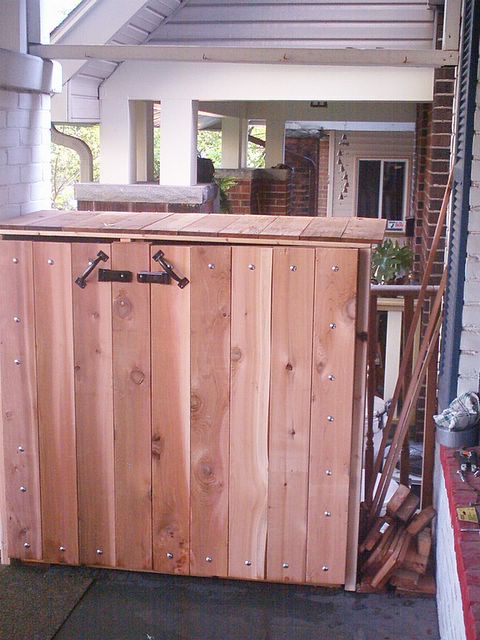
Last year I undertook the rather simple project of raccoon-proofing the bird-feeders. This spring the task was Herculean by comparison - building a critter-proof enclosure for the lovely green-bin - as well as hiding all of the other debris.
Hurray - perhaps I'll finally be able to sit on the front porch - $250 dollars and 20 hours of work later. Sighhhh!

Raccoon (and probably bear proof!) garbage and recycle box
Hurray - perhaps I'll finally be able to sit on the front porch - $250 dollars and 20 hours of work later. Sighhhh!
Raccoon (and probably bear proof!) garbage and recycle box
Thursday, May 18, 2006
A BIG Toronto story
It seems that Howard Moscoe will have some stiff competition on the race for the civic incompetence prize. The Bowmanville Zoo has been acquitted of the charge of illegally showing an elephant on the streets of Toronto.
Toronto Star - May 18 2006
It seems that the by-law officer filing the charge failed to take notes about what was on a placard near the animal. Since zoos are allowed to bring animals to the city of educational purposes, the by-law officers lapse sunk the case. As The Star reports:
In his final decision Justice of the Peace Kevin Madigan reprimanded the city's solicitor for bringing the case forward, suggesting it was a "serious inconvenience" to the defendants and the court system.
The ruling came after Geoff Uyeno, the prosecutor from the City Solicitor's office, surprised Madigan by asking that the defendant be acquitted of all charges because testimony gave proof of a bona fide educational program.
hmm - goes to prove the elephantine stupidity rampant at city hall.
Toronto Star - May 18 2006
It seems that the by-law officer filing the charge failed to take notes about what was on a placard near the animal. Since zoos are allowed to bring animals to the city of educational purposes, the by-law officers lapse sunk the case. As The Star reports:
In his final decision Justice of the Peace Kevin Madigan reprimanded the city's solicitor for bringing the case forward, suggesting it was a "serious inconvenience" to the defendants and the court system.
The ruling came after Geoff Uyeno, the prosecutor from the City Solicitor's office, surprised Madigan by asking that the defendant be acquitted of all charges because testimony gave proof of a bona fide educational program.
hmm - goes to prove the elephantine stupidity rampant at city hall.
Tuesday, May 16, 2006
Herbicides no - Urbicide Yes
The Globe & Mail's Margaret Wente describes the all too litter strewn state of the City all too accurately in her column today.
Reports Wente on the experience of a couple from a recent visit:
The other day, someone from out of town e-mailed me in a state of shock. He and his wife had just ventured downtown for the first time in a couple of years. They were horrified at the mess. They thought we were having a garbage strike.
Well, I don't go downtown myself very often anymore. The litter, the panhandlers and the general lack of interesting retail add up to me either shopping at home in The Beach - or zipping down the Gardiner to Sherway Gardens.
However, even in the glorious Beach, there are cracks. Likely due to a combination of the the City's decision to discontinue the use of pesticides - and the super-sized wages it pays - our parks have turned into fields of weeds.
Filth, muck and weeds do not a liveable city make. Herbicides have been deemed safe by Health Canada. In contrast, David Miller's regime seems to be successfully committing 'urbicide' against this city.
Reports Wente on the experience of a couple from a recent visit:
The other day, someone from out of town e-mailed me in a state of shock. He and his wife had just ventured downtown for the first time in a couple of years. They were horrified at the mess. They thought we were having a garbage strike.
Well, I don't go downtown myself very often anymore. The litter, the panhandlers and the general lack of interesting retail add up to me either shopping at home in The Beach - or zipping down the Gardiner to Sherway Gardens.
However, even in the glorious Beach, there are cracks. Likely due to a combination of the the City's decision to discontinue the use of pesticides - and the super-sized wages it pays - our parks have turned into fields of weeds.
Filth, muck and weeds do not a liveable city make. Herbicides have been deemed safe by Health Canada. In contrast, David Miller's regime seems to be successfully committing 'urbicide' against this city.
Tuesday, May 09, 2006
Steve Munro's comment and discussion
Steve Munro was kind enough to comment on this blog's recent commentary on a post in his blog. Writes Steve:
The last time I went to the Gladstone, I waited for the Dufferin Bus southbound at Bloor for 20 minutes in the afternoon rush hour. Eventually, I got a ride from a friend who passed by in her car. So much for the reliability of bus service.
J. Albert - I'll agree that schedule reliability is low on the TTC. Both Bus and streetcar languish in the 55-65% range last time I checked the CGM reports. In contrast, the STM (Montreal's transit provider) achieves roughly 80% adherence - with performance improving from 78.9% in 2001 to 82.6% in 2004. (It should be noted that the STM uses a tighter tolerance: -1 min, + 3 min, compared with the +/- 3 minutes used for the TTC metrics.)
However, there is a distinction between TTC bus and streetcar service. The TTC actually tries to alleviate bunching problems by short turning cars. It's questionable whether - on the whole - this practice improves the service offering. You can just as easily customers by booting them off a vehicle as you can by making them wait. Yet the short turn is the only real tool the TTC has for adjusting service on streetcar routes.
Bus service can be more easily adjusted by allowing buses on busy routes to play 'hopscoth'. The STM has done this for years - allowing emptier buses to pass full ones on the same route. I've never seen this on the TTC - not to say that it doesn't happen.
It would be interesting to see statistics on more extreme deviations from schedule. How many times is it out by 5, 7, 10 minutes?
The problem with a lot of the streetcar service is that there isn't enough of it and what there is is poorly managed. Moreover, the streetcar routes took a disproportionate hit back in the 1990s during the system-wide cutbacks, and it's no surprise that people think bus routes are more reliable.
J. Albert - As a rider, I can't say that I wouldn't like more service. However, it seems to me that the economics dictate against a 'frequent service' model for streetcar/LRT service - both immediately, and long term. There's some debate about how much true spare factor the TTC has with the existing fleet. During PM rush, the streetcar yards on Queen E. are pretty sparse - but the garage is usually pretty full. Is the TTC holding back - or is it simply the case that the vehicles are in the shop?
In the longer term, the price tab for CLRV replacement appears to be about $4 million a pop ($3 million from earlier estimate + $1 million estimated for TTC required modifications. In contrast, the STM is acquiring buses (2003-2007 contract) at about $460,000 each. Like it or not, buses are mass produced and inexpensive - especially when very large orders are placed - wheras LRT vehicles are not.
When the TTC replaces streetcars with buses, there are always far more buses at closer headways than the streetcars they replaced. This is related to my concern about new larger streetcars where we may see headways stretched even further. It's the wait and the uncertainty that drives riders mad, and you can do that with buses as easily as with streetcars.
J. Albert - As I alluded to above, its plain economics that will push the TTC to longer headways with larger vehicles. My take is that the TTC should:
- decide which existing streetcar routes can be succesfully transitioned to be LRT routes
- this would involve realignment and lengthening of some routes and conversion to buses for others. Perhaps the TTC could swap some of its property to help make property acquisition more economical.
- an important objective of the realignment would be to allow the TTC to run standard LRT cars without major modifications. (The savings here would also provide a source of funding to pay for property aquisition.)
The last time I went to the Gladstone, I waited for the Dufferin Bus southbound at Bloor for 20 minutes in the afternoon rush hour. Eventually, I got a ride from a friend who passed by in her car. So much for the reliability of bus service.
J. Albert - I'll agree that schedule reliability is low on the TTC. Both Bus and streetcar languish in the 55-65% range last time I checked the CGM reports. In contrast, the STM (Montreal's transit provider) achieves roughly 80% adherence - with performance improving from 78.9% in 2001 to 82.6% in 2004. (It should be noted that the STM uses a tighter tolerance: -1 min, + 3 min, compared with the +/- 3 minutes used for the TTC metrics.)
However, there is a distinction between TTC bus and streetcar service. The TTC actually tries to alleviate bunching problems by short turning cars. It's questionable whether - on the whole - this practice improves the service offering. You can just as easily customers by booting them off a vehicle as you can by making them wait. Yet the short turn is the only real tool the TTC has for adjusting service on streetcar routes.
Bus service can be more easily adjusted by allowing buses on busy routes to play 'hopscoth'. The STM has done this for years - allowing emptier buses to pass full ones on the same route. I've never seen this on the TTC - not to say that it doesn't happen.
It would be interesting to see statistics on more extreme deviations from schedule. How many times is it out by 5, 7, 10 minutes?
The problem with a lot of the streetcar service is that there isn't enough of it and what there is is poorly managed. Moreover, the streetcar routes took a disproportionate hit back in the 1990s during the system-wide cutbacks, and it's no surprise that people think bus routes are more reliable.
J. Albert - As a rider, I can't say that I wouldn't like more service. However, it seems to me that the economics dictate against a 'frequent service' model for streetcar/LRT service - both immediately, and long term. There's some debate about how much true spare factor the TTC has with the existing fleet. During PM rush, the streetcar yards on Queen E. are pretty sparse - but the garage is usually pretty full. Is the TTC holding back - or is it simply the case that the vehicles are in the shop?
In the longer term, the price tab for CLRV replacement appears to be about $4 million a pop ($3 million from earlier estimate + $1 million estimated for TTC required modifications. In contrast, the STM is acquiring buses (2003-2007 contract) at about $460,000 each. Like it or not, buses are mass produced and inexpensive - especially when very large orders are placed - wheras LRT vehicles are not.
When the TTC replaces streetcars with buses, there are always far more buses at closer headways than the streetcars they replaced. This is related to my concern about new larger streetcars where we may see headways stretched even further. It's the wait and the uncertainty that drives riders mad, and you can do that with buses as easily as with streetcars.
J. Albert - As I alluded to above, its plain economics that will push the TTC to longer headways with larger vehicles. My take is that the TTC should:
- decide which existing streetcar routes can be succesfully transitioned to be LRT routes
- this would involve realignment and lengthening of some routes and conversion to buses for others. Perhaps the TTC could swap some of its property to help make property acquisition more economical.
- an important objective of the realignment would be to allow the TTC to run standard LRT cars without major modifications. (The savings here would also provide a source of funding to pay for property aquisition.)
Wednesday, May 03, 2006
Munro let's cat out of bag
I don't normally reference other writer's blogs. Today, I thought I'd make an exception by highlighting a recent post on Steve Munro's blog. In case you've never heard of Mr. Munro, he's the person most directly responsible for 'saving' Toronto's streetcars. Munro convinced the TTC to keep streetcars in service because they provide greater capacity than buses.
Now I don't believe that assertion has been borne out. All the evidence points to buses providing equal or perhaps slightly better capacity - all other factors being equal.
Well - in a recent post:
Service Quality: What tax cuts don't give us
Munro points out the service failings of the the streetcar system.
"...I arrived at Queen and Spadina on a southbound 510 just in time to see not one, not two, but three 501 Queen cars leave westbound. Hmmm. Not a good sign. As things turned out, the next 501 (actually two of them) did not show up for 25 minutes, and the first car was going only to Roncesvalles. Fortunately for me, the Gladstone is not in Long Branch."
Well - not lucky for other people.
"...On the trip home, a bit after midnight, the eastbound 501 showed up reasonably promptly and the trip across Queen was uneventful. We pulled up to Broadview just behind a 504 King car, the one that should have taken me home. Did it wait for transfer passengers from the 501? No. At least the following 504, about 10 minutes later, was not short turned (this happens regularly late at night when I attempt this route home)..."
This happens all the time - rather than being isolated incidents.
Munro admits:
Service on the Dufferin bus seemed to be running smoothly any time I peeked out the door or window from the bar at the Gladstone [please note how this demonstrates my commitment to monitoring the TTC, and the places I will lurk to do so].
This is the experience of many TTC riders - bus service is more reliable and faster. I've talked to a number of people who ride on St. Clair West. During the (all too) brief period during which the TTC was running buses, service was more reliable and way faster than on the normal streetcar service.
Munro is truly dedicated to transit. I admire the time he's devoted to the issue. He seems far more knowledgeable that many of those actually running the system. However, Munro's made his intellectual bed by adviocating streetcars (and now "LRT") before other options. It would be difficult to climb down from the position given the history.
Now I don't believe that assertion has been borne out. All the evidence points to buses providing equal or perhaps slightly better capacity - all other factors being equal.
Well - in a recent post:
Service Quality: What tax cuts don't give us
Munro points out the service failings of the the streetcar system.
"...I arrived at Queen and Spadina on a southbound 510 just in time to see not one, not two, but three 501 Queen cars leave westbound. Hmmm. Not a good sign. As things turned out, the next 501 (actually two of them) did not show up for 25 minutes, and the first car was going only to Roncesvalles. Fortunately for me, the Gladstone is not in Long Branch."
Well - not lucky for other people.
"...On the trip home, a bit after midnight, the eastbound 501 showed up reasonably promptly and the trip across Queen was uneventful. We pulled up to Broadview just behind a 504 King car, the one that should have taken me home. Did it wait for transfer passengers from the 501? No. At least the following 504, about 10 minutes later, was not short turned (this happens regularly late at night when I attempt this route home)..."
This happens all the time - rather than being isolated incidents.
Munro admits:
Service on the Dufferin bus seemed to be running smoothly any time I peeked out the door or window from the bar at the Gladstone [please note how this demonstrates my commitment to monitoring the TTC, and the places I will lurk to do so].
This is the experience of many TTC riders - bus service is more reliable and faster. I've talked to a number of people who ride on St. Clair West. During the (all too) brief period during which the TTC was running buses, service was more reliable and way faster than on the normal streetcar service.
Munro is truly dedicated to transit. I admire the time he's devoted to the issue. He seems far more knowledgeable that many of those actually running the system. However, Munro's made his intellectual bed by adviocating streetcars (and now "LRT") before other options. It would be difficult to climb down from the position given the history.
Monday, May 01, 2006
Bus vs LRT - The winner is the bus!
The WWW has more than its share of information polution from the light-rail lobby. One doesn't have to look far to see LRT advocates' Pavlovian slobbering over the latest LRT news. LRT will move the world and is the greatest thing since sliced bread.
These sites and posts often include pictures - and otfen a good dollup of anti-bus/BRT propaganda as well.
I've put together a quick comparison of real-world bus and LRT performance. This compares the performance of the top performing transit agency in North America - Montreal's STM - and prominent LRT and streetcar systems. This compares the boardings per route/KM for different services for weekday service.
The comparison reveals that Montreal's busiest bus routes are outperforming LRT and streetcars. Only Calgary's C-Train system is comparable in attracting passengers - and that system is on the cusp between being an LRT in terms of a street-railway - and a mini-subway.

Transit effectiveness comparison
The route lengths for the STM and TTC streetcar routes were estimated from route maps. (Note - the TTC's streetcar track network is actually about 150 km - but much of that is not directly used in revenue service - but for moving cars to active routes and short turning cars. All US statistics are from the APTA website.
These sites and posts often include pictures - and otfen a good dollup of anti-bus/BRT propaganda as well.
I've put together a quick comparison of real-world bus and LRT performance. This compares the performance of the top performing transit agency in North America - Montreal's STM - and prominent LRT and streetcar systems. This compares the boardings per route/KM for different services for weekday service.
The comparison reveals that Montreal's busiest bus routes are outperforming LRT and streetcars. Only Calgary's C-Train system is comparable in attracting passengers - and that system is on the cusp between being an LRT in terms of a street-railway - and a mini-subway.

Transit effectiveness comparison
The route lengths for the STM and TTC streetcar routes were estimated from route maps. (Note - the TTC's streetcar track network is actually about 150 km - but much of that is not directly used in revenue service - but for moving cars to active routes and short turning cars. All US statistics are from the APTA website.
Sunday, April 30, 2006
Tortuous train logic
As if it isn't difficult enough to follow what is happenning with transit in Toronto, today's Toronto Star editorial really muddies the waters on possible options for handling the obsolescence of the Scarborough RT line:
`Trains' of streetcars best for Scarborough - Toronto Star - April 30 2006
The Star comes out swinging in support of the option #2 - which is describes as using 'Trains' of streetcars. Well, for many people, this is hardly a way to sell the idea! Option #2 is actually to convert the line to "light rail". The Star get's is all confused labelling this:
...Switching from light rail cars to new streetcars that could be linked into "trains" on the existing rapid transit route...
whereas in the options, this is the light rail option.
Part of the problem is that there has been so much propaganda over the years about transit in the city, that now few people know which way is up. "LRT" is labelled as "streetcar" OR not depending on the hidden agenda of the proponent.
The Star further confuses matters:
The future of mass transit in Scarborough is likely to be found in a report released last week outlining three options for replacing the area's decaying light rail system.
Firstly, the report hasn't been released - rather the study has narrowed the options and is gathering public input. Second, the line isn't decaying - it simply uses equipment that no-one else in the world ended up buying into.
Neither is the RT 'worn out' nor are it's cars 'antiquated'. In fact, the line is newer (1985) than the original sections of Calgary's C-Train system (1981). The sad fact - for Toronto - is that we bet on the wrong technology - whereas Calgary purchased off-the shelf equipment that was (and is) in wide use in parts of Europe.
The option to now use LRT technology (i.e. the option #2 being touted in the editorial) faces a major problem: the plan is not to use off-the-shelf technology, but rather equipment that will highly customized/modified so that it can run on the downtown streetcar tracks. Not only does this add $1 million to the price tag for each vehicle, it means that the TTC will be facing the same obsolescence problem a few decades hence!
`Trains' of streetcars best for Scarborough - Toronto Star - April 30 2006
The Star comes out swinging in support of the option #2 - which is describes as using 'Trains' of streetcars. Well, for many people, this is hardly a way to sell the idea! Option #2 is actually to convert the line to "light rail". The Star get's is all confused labelling this:
...Switching from light rail cars to new streetcars that could be linked into "trains" on the existing rapid transit route...
whereas in the options, this is the light rail option.
Part of the problem is that there has been so much propaganda over the years about transit in the city, that now few people know which way is up. "LRT" is labelled as "streetcar" OR not depending on the hidden agenda of the proponent.
The Star further confuses matters:
The future of mass transit in Scarborough is likely to be found in a report released last week outlining three options for replacing the area's decaying light rail system.
Firstly, the report hasn't been released - rather the study has narrowed the options and is gathering public input. Second, the line isn't decaying - it simply uses equipment that no-one else in the world ended up buying into.
Neither is the RT 'worn out' nor are it's cars 'antiquated'. In fact, the line is newer (1985) than the original sections of Calgary's C-Train system (1981). The sad fact - for Toronto - is that we bet on the wrong technology - whereas Calgary purchased off-the shelf equipment that was (and is) in wide use in parts of Europe.
The option to now use LRT technology (i.e. the option #2 being touted in the editorial) faces a major problem: the plan is not to use off-the-shelf technology, but rather equipment that will highly customized/modified so that it can run on the downtown streetcar tracks. Not only does this add $1 million to the price tag for each vehicle, it means that the TTC will be facing the same obsolescence problem a few decades hence!
Friday, April 28, 2006
Subway to Scaborough???
Earlier this week- and it's been a very long week - I attended a presentation and Q&A session about the options being considered for replacing etc. the Scarborough RT system. The rolling stock used on the line will have worn out by 2015. Given how long it can take to make transit decisions involving any type of track-based RT, this might give us enough time to have a solution in place.
The crux of the issue is that no-one ever bought into the Ontario-sponsored car design. Replacement cars are not available on the market - and it's deemed too costly to have them custom-built.
Prof. Richard Soberman is spearheading the study. At this stage of the studt, three high-level options are being considered:
1. Replace the existing RT with upgraded technology
- 'Mark II' RT rolling stock - as used in Vancouver on the Sky Train - would be purchased
- the track would be modified to handle the new cars
- the line would be out of service for about 18 months
This option was the lowest cost with the least amount of service disruption.
2. Replace the RT technology with LRT type trains that use overhead wires
- this envisages using the same vehicle design as the TTC might use to replace its existing streetcar
This option has higher costs than #1 because:
- a number of stations must undergo major reconstruction to handle the low floor loading envisaged on the new cars
- because the TTC wishes to use the same design as for the streetcar replacements, there is a bump of about $1,000,000 per car - as the TTC projects this is what it will take to modify off-the-shelf LRT equipment for the downtown street track network
My take is that this option should be shelved because of the requirement for non-standard cars. This puts us back in the same long term predicament - expensive and eventually unreliable and unservicable cars. Unless the TTC bites the bullet and goes with off-the-shelf technology for LRT in general - scratch option #2.
3. A subway line from Kennedy to Scarborough Town Center
This would run on a different route than the existing RT. In addition, the number of stations would be reduced.
Price tag is $1.2 billion + some land and utilities costs.
The meeting was interesting. There were many politicians in attendance. Scarborough coucillors - and the majority of deputants - prefer the subway option. I'm leaning that way as well - for the following reasons:
- it will use standard technology - i.e. subway cars
- it eliminates the transfer between the line and the existing subway
- in the long term, a transit system based on investment in subway + supporting buses - such as in Montreal - is delivering better cost and ridership performance than any other North American system.
The crux of the issue is that no-one ever bought into the Ontario-sponsored car design. Replacement cars are not available on the market - and it's deemed too costly to have them custom-built.
Prof. Richard Soberman is spearheading the study. At this stage of the studt, three high-level options are being considered:
1. Replace the existing RT with upgraded technology
- 'Mark II' RT rolling stock - as used in Vancouver on the Sky Train - would be purchased
- the track would be modified to handle the new cars
- the line would be out of service for about 18 months
This option was the lowest cost with the least amount of service disruption.
2. Replace the RT technology with LRT type trains that use overhead wires
- this envisages using the same vehicle design as the TTC might use to replace its existing streetcar
This option has higher costs than #1 because:
- a number of stations must undergo major reconstruction to handle the low floor loading envisaged on the new cars
- because the TTC wishes to use the same design as for the streetcar replacements, there is a bump of about $1,000,000 per car - as the TTC projects this is what it will take to modify off-the-shelf LRT equipment for the downtown street track network
My take is that this option should be shelved because of the requirement for non-standard cars. This puts us back in the same long term predicament - expensive and eventually unreliable and unservicable cars. Unless the TTC bites the bullet and goes with off-the-shelf technology for LRT in general - scratch option #2.
3. A subway line from Kennedy to Scarborough Town Center
This would run on a different route than the existing RT. In addition, the number of stations would be reduced.
Price tag is $1.2 billion + some land and utilities costs.
The meeting was interesting. There were many politicians in attendance. Scarborough coucillors - and the majority of deputants - prefer the subway option. I'm leaning that way as well - for the following reasons:
- it will use standard technology - i.e. subway cars
- it eliminates the transfer between the line and the existing subway
- in the long term, a transit system based on investment in subway + supporting buses - such as in Montreal - is delivering better cost and ridership performance than any other North American system.
Wednesday, April 26, 2006
Toronto's vanishing vendors
Today, the City chased away yet another service supplier. Union Pearson Group - who won the competition to refurbish and redevelop Union Station is indicating that there is insufficient time to prepare contractual documents before the current deadline.
The Toronto Star - April 26 2006
Mayor Miller is blaming the vendor - saying:
"Council bent over backwards to provide extension after extension," he said yesterday. "There was a deadline set, it was a fair deadline and this building's too important to keep it essentially in a holding pattern."
Well, it's hard to believe that Union Pearson is walking away from the deal because it has been dilly-dallying. What's next - will the Mayor be claiming that the word gullible is not in the OED?
Let's get real. The City already chased off Wilson Logistics - who were hauling our trash to Michigan - and Cresford Developments Coroporation - who were lined up to rebuild parts of Regents Park.
I believe this pattern is further indication of the long-term damage Miller is doing to the City. No doubt, it already has the reputation that it will not be dealing in good faith. This chases away possible bidders - and pushes up the cost of services acquired. (hmmm - not that Miller gives a rip.)
The Toronto Star - April 26 2006
Mayor Miller is blaming the vendor - saying:
"Council bent over backwards to provide extension after extension," he said yesterday. "There was a deadline set, it was a fair deadline and this building's too important to keep it essentially in a holding pattern."
Well, it's hard to believe that Union Pearson is walking away from the deal because it has been dilly-dallying. What's next - will the Mayor be claiming that the word gullible is not in the OED?
Let's get real. The City already chased off Wilson Logistics - who were hauling our trash to Michigan - and Cresford Developments Coroporation - who were lined up to rebuild parts of Regents Park.
I believe this pattern is further indication of the long-term damage Miller is doing to the City. No doubt, it already has the reputation that it will not be dealing in good faith. This chases away possible bidders - and pushes up the cost of services acquired. (hmmm - not that Miller gives a rip.)
Tuesday, April 25, 2006
Homeless hokum
Sue-Ann Levy of The Toronto Sun sheds a little light on Toronto's sol-called homeless advocates who seem a surprisingly uninterested in getting Toronto's hobo population off the streets.
Sue-Ann Levy - Toronto Sun - April 25 2006
However, it really isn't all that surprising. First, as Ms. Levy points out, Toronto's homeless industry is a large employer. Toronto's hostels alone employ on the order of 600-700 people. In addition, social activists use the use to make a name for themselves
In addition, the real objective of groups such as the Toronto Disaster Relief Committee is to get the federal government involved in pumping money into new public housing projects. This despite the fact that roughly 10% of all dwellings in Toronto are part of social housing. In my view, the real agenda in needlessly building ever more government owned housing is to slowly squeeze the private sector out of the housing market.
It's a long term socialist goal to make people dependent on the state for housing. I saw this first hand in England back in the early 1970's. The local council used compulsory purchase orders to purchase my family's and other's home and convert the entire block into a council development. There was no pressing need for this - it was simply part of the long term agenda to squeeze out the middle class. It worked, we moved back to Canada. Thankfully the council had to pay a very large price for our home!
The real disaster for the TDRC woukd be if Toronto solved the homeless problem on its own - as it would prove that the federal government doesn't need to spend money on the problem.
Sue-Ann Levy - Toronto Sun - April 25 2006
However, it really isn't all that surprising. First, as Ms. Levy points out, Toronto's homeless industry is a large employer. Toronto's hostels alone employ on the order of 600-700 people. In addition, social activists use the use to make a name for themselves
In addition, the real objective of groups such as the Toronto Disaster Relief Committee is to get the federal government involved in pumping money into new public housing projects. This despite the fact that roughly 10% of all dwellings in Toronto are part of social housing. In my view, the real agenda in needlessly building ever more government owned housing is to slowly squeeze the private sector out of the housing market.
It's a long term socialist goal to make people dependent on the state for housing. I saw this first hand in England back in the early 1970's. The local council used compulsory purchase orders to purchase my family's and other's home and convert the entire block into a council development. There was no pressing need for this - it was simply part of the long term agenda to squeeze out the middle class. It worked, we moved back to Canada. Thankfully the council had to pay a very large price for our home!
The real disaster for the TDRC woukd be if Toronto solved the homeless problem on its own - as it would prove that the federal government doesn't need to spend money on the problem.
Saturday, April 15, 2006
More TTC pipe dreams
The TTC is (again?) studying running its money-slurping streetcars as trains:
Kevin McGran - Toronto Star - April 15 2006
As with most everything to do with the TTC and especially the streetcars operations, it's just a dream. The cars don't have couplers.
Perhaps couplers could be added if the TTC goes ahead with the major bebuild of the CLRV fleet - the CLRVs are the smaller streetcars that operate on the King St route. However, will simply coupling the cars together work? Will there be an operator in each car? How will the motive power be synchronized between the different units? What will reliability be like? What will the passenger experience be like?
I'll answer the last two questions - just as crappy as today. These vehicle are not designed to run as trains. They aren't reliable enough - and don't have the passenger exit/egress capacity to provide effective transit.
The problem today is bunching.
During rush hour they're supposed to be two minutes apart, but before you know it, a bunch of them end up travelling together. Up ahead, impatient passengers push to get into the first car that shows up, even if it's already packed, putting the "first" one further behind schedule and slowing down the rest.
Although the article blames the ever scapegoated factor of other vehicular traffic, the real problem is the vehicles and the entire service design. The Spadina LRT (sic) has much the same problem despite having dedicated lanes. Montreal doesn't have the same problem - because its buses can pass each other - alleviating bunching.
One thing is becoming clearer by the day - the TTC is being run by amateurs.
Kevin McGran - Toronto Star - April 15 2006
As with most everything to do with the TTC and especially the streetcars operations, it's just a dream. The cars don't have couplers.
Perhaps couplers could be added if the TTC goes ahead with the major bebuild of the CLRV fleet - the CLRVs are the smaller streetcars that operate on the King St route. However, will simply coupling the cars together work? Will there be an operator in each car? How will the motive power be synchronized between the different units? What will reliability be like? What will the passenger experience be like?
I'll answer the last two questions - just as crappy as today. These vehicle are not designed to run as trains. They aren't reliable enough - and don't have the passenger exit/egress capacity to provide effective transit.
The problem today is bunching.
During rush hour they're supposed to be two minutes apart, but before you know it, a bunch of them end up travelling together. Up ahead, impatient passengers push to get into the first car that shows up, even if it's already packed, putting the "first" one further behind schedule and slowing down the rest.
Although the article blames the ever scapegoated factor of other vehicular traffic, the real problem is the vehicles and the entire service design. The Spadina LRT (sic) has much the same problem despite having dedicated lanes. Montreal doesn't have the same problem - because its buses can pass each other - alleviating bunching.
One thing is becoming clearer by the day - the TTC is being run by amateurs.
Friday, April 14, 2006
TDSB plays Machiavelli
I wish I could say that the revelations in Moira MacDonald's column (Toronto Sun - April 10 2006) shocked and disturbed me. What's disturbing that the antics and machinations of too many of our shool board trustees have lost their shock factor. In my view, the real crisis in education in Toronto is a crisis of governance - or a lack thereof to be more accurate.
The trustees at the TDSB have yet to find a new Director of Education. Neither have they a long term plan to manage the Board's real estate portfolio to better fit the demographic shift in student population to suburban areas.
I can certainly understand Gerard Kennedy's bailing out of the education portfolio to take a run at federal politics. For Kennedy's ill-advised restoration of the trustees' powers, his various hand-holding sessions, and his granting of various financial goodies, his reward was to be a Machiavellian stab in the back. As they say, no good deed goes unpunished.
The trustees at the TDSB have yet to find a new Director of Education. Neither have they a long term plan to manage the Board's real estate portfolio to better fit the demographic shift in student population to suburban areas.
I can certainly understand Gerard Kennedy's bailing out of the education portfolio to take a run at federal politics. For Kennedy's ill-advised restoration of the trustees' powers, his various hand-holding sessions, and his granting of various financial goodies, his reward was to be a Machiavellian stab in the back. As they say, no good deed goes unpunished.
Tuesday, April 11, 2006
Toronto's light rail dreams - er nightmares
Kevin McGran writes that Toronto is like no other city in the world.
TTC shops for streetcars - Toronto Star - April 10 2006
Perhaps so, but let us not ascribe this to its geography.
Toronto's transit officials reveal the expense and difficulty - or even impossibility - of replacing the TTC's streetcar fleet. Meanwhile TTC chair Howard Moscoe openly admits that the existing versions are costly to operate and not accessible to the disabled. Surely the technical and economic feasibility of acquiring effective replacements should be assured before considering extending rails to the far corners of the metropolis.
It seems then that what makes Toronto unique is that it is embarking on an ill-advised venture into light-rail - without any semblance of a transportation or financial plan.
TTC shops for streetcars - Toronto Star - April 10 2006
Perhaps so, but let us not ascribe this to its geography.
Toronto's transit officials reveal the expense and difficulty - or even impossibility - of replacing the TTC's streetcar fleet. Meanwhile TTC chair Howard Moscoe openly admits that the existing versions are costly to operate and not accessible to the disabled. Surely the technical and economic feasibility of acquiring effective replacements should be assured before considering extending rails to the far corners of the metropolis.
It seems then that what makes Toronto unique is that it is embarking on an ill-advised venture into light-rail - without any semblance of a transportation or financial plan.
Wednesday, March 29, 2006
The Barber whine
The Globe's official NDP rep John Barber repeats his whining about Ontario's Current Value Assessment system.
A provincial ombudsman has just pilloried the bureaucracy responsible for calculating the assessments for among other things, demonstraing 'obduracy in its ways' Gasp - a bureaucracy being obdurate! What's next, we find an ocean that has water?
Of course Barber's complaint about the system is personal. He lives in the Annex - a tawny, centrally-located neighbourhood that is comfortable walking distance from a good deal of downtown. It's also straddled by two subway lines. It's hardly surprising that property values in his area have risen. A grade three math dropout could calculate the value of a house in the Annex - and it will still have risen faster than that of a house in less-central, transportation-starved areas of the city.
Barber's contention is that the poor people in the low-rent districts should bear more of the ever increasing property tax burden - while the lucky few in the Annex, Forest Hill etc. are protected.
If Barber really wanted to curtail his property tax increase, he wouldn't be deifying David Miller all the time.
A provincial ombudsman has just pilloried the bureaucracy responsible for calculating the assessments for among other things, demonstraing 'obduracy in its ways' Gasp - a bureaucracy being obdurate! What's next, we find an ocean that has water?
Of course Barber's complaint about the system is personal. He lives in the Annex - a tawny, centrally-located neighbourhood that is comfortable walking distance from a good deal of downtown. It's also straddled by two subway lines. It's hardly surprising that property values in his area have risen. A grade three math dropout could calculate the value of a house in the Annex - and it will still have risen faster than that of a house in less-central, transportation-starved areas of the city.
Barber's contention is that the poor people in the low-rent districts should bear more of the ever increasing property tax burden - while the lucky few in the Annex, Forest Hill etc. are protected.
If Barber really wanted to curtail his property tax increase, he wouldn't be deifying David Miller all the time.
Sunday, March 26, 2006
More on the GTTA
er well - not much more.
The Ontario Fiberals unveiled their latest budget this pas week. We were expecting details on how a GTA transit authority - to be established as the Greater Toronto Transit Authority - would work. All we have so far is the McGuinty and Co plan to introduce:
legislation in 2006 to establish the Greater Toronto Transportation Authority (GTTA). The proposed GTTA would help achieve the objectives of the Growth Plan for the Greater Golden Horseshoe and the Greenbelt Plan by leading the delivery of an integrated and more convenient transportation system to meet the growing needs of the GTA and Hamilton. The GTTA would plan, coordinate and set priorities for public transit investments and major regional roads;
In the same budget, they set about planning and prioritizng transit without such a body:
- The Spadina subway will be extended well into York Region (assuming Toronto, York Region and the Feds come up with matching contributions)
- Mississauga and Brampton will get funding to bus rapid transit initiatives,
- Toronto get's another bailout (not really ay all disguised as funding for subway operations)
- meanwhile, Durham Region is out of luck.
So why do we need a GTTA when the Province seems able to make such decisions on its own?
The Ontario Fiberals unveiled their latest budget this pas week. We were expecting details on how a GTA transit authority - to be established as the Greater Toronto Transit Authority - would work. All we have so far is the McGuinty and Co plan to introduce:
legislation in 2006 to establish the Greater Toronto Transportation Authority (GTTA). The proposed GTTA would help achieve the objectives of the Growth Plan for the Greater Golden Horseshoe and the Greenbelt Plan by leading the delivery of an integrated and more convenient transportation system to meet the growing needs of the GTA and Hamilton. The GTTA would plan, coordinate and set priorities for public transit investments and major regional roads;
In the same budget, they set about planning and prioritizng transit without such a body:
- The Spadina subway will be extended well into York Region (assuming Toronto, York Region and the Feds come up with matching contributions)
- Mississauga and Brampton will get funding to bus rapid transit initiatives,
- Toronto get's another bailout (not really ay all disguised as funding for subway operations)
- meanwhile, Durham Region is out of luck.
So why do we need a GTTA when the Province seems able to make such decisions on its own?
Wednesday, March 22, 2006
And now for something completely different
If the reports are correct, tomorrow's Ontario budget will announce the creation of a GTA-wide 'body' of some type that will play a role in transit in the region. The probable name for this organization will be the Greater Toronto Transit Authority or GTTA. The big $$$ question is whether this will be a true authority will decision making capabilities - or a rehash of the old Greater Toronto Services Board (GTSB). No doubt the Fiberals will try to come up with a compromise. This won't work. In reality, a management board either has true authority, or it doesn't. But I'll write about this another time.
In recent days, Prime Minister Harper has stirred controversy by using the phrase 'God bless Canada'. This shouldn't be all that controversional - seeing that our near-and-dear Charter of Rights and Freedoms invokes the 'supremacy of God'. This has made me consider whether there is indeed a God?
Last night, I was browsing through Brian Greene's The Elegant Universe. In one of the later chapters he discusses the formation of the universe. There is now a clear concensus that the universe as we know it came about in a singular creation event - The Big Bang. Greene discusses how the universe may have unfolded after the bang (or ATB). Cosmologists are hard at work understanding the chronology of and physics behind how the universe expanded in the first infinitessimal fractions of a second.
Even with a degree in applied physics from Cornell, I struggle somewhat with the underlying science. String theories were only a rumour back when I was on campus. However, two things are clear to me:
1. There was a creation event
2. The mechanics of the creation event are perfectly hidden.
Let me explain the second assertion. Physicists have measured the level of background radiation from the Big Bang. This level (basically a temperature) is uniform in all directions. This finding caused earlier models of the universe's expansion to have to be set aside - as they would not have allowed the temperature to come to an equilibrium. Instead, the current thinking is that the universe inflated very rapidly during the first 10 E-35 seconds or so - growing by 10 e+30 in size.
However, this is conjecture only. Why - because the uniformity of measured temperature. It's as if someone came along and smoothed out all the footprints on the beach, cleaned up all of the fingerprints on the glasses. The direct evidence of our creation has been hidden.
It seems to be that an all-powerful entity - should he (she or it) decide to create a universe - would arrange to perfectly hide the evidence from sentient beings within his new creation. This doesn't prove that God exists - but it shows that the universe's creation fits with such a theory.
In recent days, Prime Minister Harper has stirred controversy by using the phrase 'God bless Canada'. This shouldn't be all that controversional - seeing that our near-and-dear Charter of Rights and Freedoms invokes the 'supremacy of God'. This has made me consider whether there is indeed a God?
Last night, I was browsing through Brian Greene's The Elegant Universe. In one of the later chapters he discusses the formation of the universe. There is now a clear concensus that the universe as we know it came about in a singular creation event - The Big Bang. Greene discusses how the universe may have unfolded after the bang (or ATB). Cosmologists are hard at work understanding the chronology of and physics behind how the universe expanded in the first infinitessimal fractions of a second.
Even with a degree in applied physics from Cornell, I struggle somewhat with the underlying science. String theories were only a rumour back when I was on campus. However, two things are clear to me:
1. There was a creation event
2. The mechanics of the creation event are perfectly hidden.
Let me explain the second assertion. Physicists have measured the level of background radiation from the Big Bang. This level (basically a temperature) is uniform in all directions. This finding caused earlier models of the universe's expansion to have to be set aside - as they would not have allowed the temperature to come to an equilibrium. Instead, the current thinking is that the universe inflated very rapidly during the first 10 E-35 seconds or so - growing by 10 e+30 in size.
However, this is conjecture only. Why - because the uniformity of measured temperature. It's as if someone came along and smoothed out all the footprints on the beach, cleaned up all of the fingerprints on the glasses. The direct evidence of our creation has been hidden.
It seems to be that an all-powerful entity - should he (she or it) decide to create a universe - would arrange to perfectly hide the evidence from sentient beings within his new creation. This doesn't prove that God exists - but it shows that the universe's creation fits with such a theory.
Monday, March 13, 2006
More 'coon fun
Well actually, the racoon didn't end up having any fun. In fact, this unfortunate creature has 'gone west' or wherever these critters go on that final garbage raid - er voyage.
I guess one could say that this racoon's died as a result of the heavy winds we sustained a few weeks ago - very early Friday. The quiet of the early morning darkness was rudely interrupted by a thunderous riping sound. One a few strands of light made their appearance, I dressed and looked about for the source of the commotion. There was nothing untowards - other than the plastic garbage bin lying on its side.
It wasn't until I returned home from work that the source of the early morning disturbance became clear - a large portion of the flat part of my roof had blown off. To be more precise, the sheeting had ripped from its mooring and was curled up - partially draped over the chimney.
I spend an hour or so trying to contact my insurance company. Due to a the effects of the storm - most notably a multi-car pileup in Eastern Ontario - this was to no avail. I had more luck in the morning. Twenty minutes after contacting the insurance company, an adjuster and contractor were on premises. By 3:30, the roof was patched temporarily.
The only loser - the unfortunate creature that somehow made its way into the crawl-space during the short time the roof was damaged. I didn't notice anything until the Sunday night - when I heard a animal on the roof - or so I thought. After a couple of nights, I decided to go up on the roof to shew the creature away - no sight. I then tried crushed mothballs - no effect.
When I arrived home the next Friday, I could hear the scratching. This convinced me that the creature was trapped in the roof. I phoned the adjuster and contractor. I could not convince them to send the roofers back to let the creature our. The contractor insisted that there was no way that a racoon could have got in - as only the membrane had ripped (there were boards underneath.)
I was not convinced - yet I couldn't think of what else to do. The scratching did go away. The following Friday, the roofers reappeared. Before wrapping up for the day, the chief roofer rang the bell - wondering if I had any problem with work proceding the next day. He also mentioned that they had evicted a sqatter - albeit a dead one - a rather large racoon.
Now I have a new flat roof - for the very manageble deductible. I feel a bit guiltly about the racoon. Perhaps I should have insisted on having the creature freed from his dark prison. However, I'm not losing any sleep over it.
I guess one could say that this racoon's died as a result of the heavy winds we sustained a few weeks ago - very early Friday. The quiet of the early morning darkness was rudely interrupted by a thunderous riping sound. One a few strands of light made their appearance, I dressed and looked about for the source of the commotion. There was nothing untowards - other than the plastic garbage bin lying on its side.
It wasn't until I returned home from work that the source of the early morning disturbance became clear - a large portion of the flat part of my roof had blown off. To be more precise, the sheeting had ripped from its mooring and was curled up - partially draped over the chimney.
I spend an hour or so trying to contact my insurance company. Due to a the effects of the storm - most notably a multi-car pileup in Eastern Ontario - this was to no avail. I had more luck in the morning. Twenty minutes after contacting the insurance company, an adjuster and contractor were on premises. By 3:30, the roof was patched temporarily.
The only loser - the unfortunate creature that somehow made its way into the crawl-space during the short time the roof was damaged. I didn't notice anything until the Sunday night - when I heard a animal on the roof - or so I thought. After a couple of nights, I decided to go up on the roof to shew the creature away - no sight. I then tried crushed mothballs - no effect.
When I arrived home the next Friday, I could hear the scratching. This convinced me that the creature was trapped in the roof. I phoned the adjuster and contractor. I could not convince them to send the roofers back to let the creature our. The contractor insisted that there was no way that a racoon could have got in - as only the membrane had ripped (there were boards underneath.)
I was not convinced - yet I couldn't think of what else to do. The scratching did go away. The following Friday, the roofers reappeared. Before wrapping up for the day, the chief roofer rang the bell - wondering if I had any problem with work proceding the next day. He also mentioned that they had evicted a sqatter - albeit a dead one - a rather large racoon.
Now I have a new flat roof - for the very manageble deductible. I feel a bit guiltly about the racoon. Perhaps I should have insisted on having the creature freed from his dark prison. However, I'm not losing any sleep over it.
Tuesday, February 28, 2006
Cauchon squeals
OK - perhaps it's some of the Liberal faithful who are squealing over Martin Cauchon's comments on health care and the fiscal imbalance:
TheStar.com - Ex-justice minister gores Liberal sacred cows
The Star chose to use a bovine metaphor - where a porcine metaphor is more appropriate.
TheStar.com - Ex-justice minister gores Liberal sacred cows
The Star chose to use a bovine metaphor - where a porcine metaphor is more appropriate.
Monday, February 27, 2006
More on St. Clair
It look as if the City's judge-shopping tactics have made the go ahead for the dedicated lanes for the St. Clair streetcar more or less likely. Exactly how the city obtained such agreeable judges when the last set were unanimous in opposition will likely remain a mystery. The SOS case appears to have been built on the City and TTC not having conducted a proper EA. However, the exact arguments used appear to have been rather esoteric points of law.
Perhaps that is in accordance will the may the law on appeals is written. To me, the bigger issue is the city's and TTC's gross dishonesty in the EA process. Can an EA be complete if it is based on falsehoods? Consider the following examples:
In my estimation, not only did the City and TTC fail to do a complete Environmental Assessment, they almost certainly allowed/encouraged/engineered the EA to proceed based on an evaluation of alternatives that they knew was not only biased, but also inaccurate. For me the telling document is Section 8 - Evaluation of Alternative Solutions:
If one looks at the key criteria applied in examining the different alternatives, it's clear that not only is the 'preferred alternative' given preferential treatment but also that the assumptions and calculations are at variance with facts in possession of the City/TTC during the course of the EA. I will divide these by subject area:
Service Attractiveness
In the evaluation of alternatives, switching to bus service (i.e. alternative #7) it is deemed that:
Buses would degrade attractiveness - future growth would be difficult
This statement is at variance with figures in an study conducted for the TTC comparing its performance on key measures to other public transit agencies. The report - prepared by IBI Group for city staff - is titled 'Review of TTC Key Performance Figures' (dated Feb 18 2003, available in the Urban Affairs Library)
Page 8 of the report report compares the number of boardings per hour for TTC buses vs. TTC streetcars. As of 2001, the numbers are:
Bus: 76 boardings/hour
Streetcar: 81 boardings/hour
The streetcar number is but slightly higher - even though the figure includes the larger ALRVs and CLRVS. If the number of prorated for the CLRVs only, it's clear that the boardings per hour for the standard streetcar (CLRV) is no greater and likely less than for buses. If the statement "buses would degrade attractiveness" were true, we should see a noticible advantage in boardings per hour for the streetcars. This is not borne out in real numbers of riders. It appears that riders give a slight edge to bus service.
Cost - operating
The comparison states that under alternative #7:
Transit operating costs would increase significantly, due to the need for more vehicles and maintenance.
This assertion is at odds with:
1. The IBI report (as alluded to above)
On page A.2, the report shows the hourly operatng costs of difefrent modes of transit in different systems. The numbers (2001) are:
TTC buses: $85.98 per hour
TTC streetcars: $133.78 per hour
Given that the TTC is achieving roughly equal boardings/hour for streetcars and buses, the numbers required to serve the route should be close. Hence, the operating cost for the bus alternative is far lower!
2. Statements by TTC official Mitch Stambler
It's not as is the operating cost issue is unknown to the TTC either. In the Globe and Mail report discussing the lack of effectiveness of the Spadina line, Mr. Stambler is quoted:
"We never argued that the that streetcars don't cost more to operate than buses"
(If you look back at the final EA report for the Spadina, you'll see that his statement is false. The economics in that report were jigged to make the LRT option look favourable vs bus service - so such a claim was indeed made by the city and TTC.)
Cost - capital
The alternatives comparson ascribes certain costs to the bus alternative:
Cost of buses $18-25 million
Cost for garage $8 million
Cost for road rebuild $13 million
yet no similar analysis is made for the streetcar ROW option.
There is an imminent need to replace (or refurbish) the CLRVs. The refurbishment of the CLRVs will cost about $1.1 million each, while replacement will cost $3-5 million. At a mininmum, $25 million or so should have been listed under alternative #6 to cover these.
I should hardly need to mention that the capital costs assumed under #6 have turned out to be incorrect - even without the vehicle replacement/refurbishment costs.
(Similar tricks were used in the Spadina assessment. The EA estimated the cost at around $70 million - including acquisition of ALRVs. The actual project cost was $140 million - and no vehicle were acquired!)
Capacity
In the comparson of alternatives, various claims are made as to the capacity advantages of streetcars. These claims are not new - however, they cannot be reconciled with:
1. The overall measure of 'boardings per hour' (as above) which show that TTC buses and streetcars are attracting and handling roughly the same number of passengers/service hour.
2. Figures for bus services offered in Montreal on HOV lanes which seem to indicate similar capacity as on the Spadina LRT line in terms of boardings per hour:
(STM [Montreal's transit system] figures state that the 535/80/165 combined route uses 53 buses as three minute intervals during peak (3 hours) - which supports 18,000 riders. This works out to about 113 boardings per hour during peak - which I believe is comparable to the Spadina LRT line - about 120/ hour. The Montreal route is much longer too - so the average length of trip is longer than on the Spadina line. )
It should be noted that the EA report uses copious white space touting other LRT systems. Most or all of these are inapplicable as points of comparison. No discussion is included as to the success of bus services in Montreal, Ottawa and Vancouver - which should be the first points of comparison in such an analysis. Montreal and Ottawa are especially important to compare - given the similarity in weather.
Perhaps that is in accordance will the may the law on appeals is written. To me, the bigger issue is the city's and TTC's gross dishonesty in the EA process. Can an EA be complete if it is based on falsehoods? Consider the following examples:
In my estimation, not only did the City and TTC fail to do a complete Environmental Assessment, they almost certainly allowed/encouraged/engineered the EA to proceed based on an evaluation of alternatives that they knew was not only biased, but also inaccurate. For me the telling document is Section 8 - Evaluation of Alternative Solutions:
If one looks at the key criteria applied in examining the different alternatives, it's clear that not only is the 'preferred alternative' given preferential treatment but also that the assumptions and calculations are at variance with facts in possession of the City/TTC during the course of the EA. I will divide these by subject area:
Service Attractiveness
In the evaluation of alternatives, switching to bus service (i.e. alternative #7) it is deemed that:
Buses would degrade attractiveness - future growth would be difficult
This statement is at variance with figures in an study conducted for the TTC comparing its performance on key measures to other public transit agencies. The report - prepared by IBI Group for city staff - is titled 'Review of TTC Key Performance Figures' (dated Feb 18 2003, available in the Urban Affairs Library)
Page 8 of the report report compares the number of boardings per hour for TTC buses vs. TTC streetcars. As of 2001, the numbers are:
Bus: 76 boardings/hour
Streetcar: 81 boardings/hour
The streetcar number is but slightly higher - even though the figure includes the larger ALRVs and CLRVS. If the number of prorated for the CLRVs only, it's clear that the boardings per hour for the standard streetcar (CLRV) is no greater and likely less than for buses. If the statement "buses would degrade attractiveness" were true, we should see a noticible advantage in boardings per hour for the streetcars. This is not borne out in real numbers of riders. It appears that riders give a slight edge to bus service.
Cost - operating
The comparison states that under alternative #7:
Transit operating costs would increase significantly, due to the need for more vehicles and maintenance.
This assertion is at odds with:
1. The IBI report (as alluded to above)
On page A.2, the report shows the hourly operatng costs of difefrent modes of transit in different systems. The numbers (2001) are:
TTC buses: $85.98 per hour
TTC streetcars: $133.78 per hour
Given that the TTC is achieving roughly equal boardings/hour for streetcars and buses, the numbers required to serve the route should be close. Hence, the operating cost for the bus alternative is far lower!
2. Statements by TTC official Mitch Stambler
It's not as is the operating cost issue is unknown to the TTC either. In the Globe and Mail report discussing the lack of effectiveness of the Spadina line, Mr. Stambler is quoted:
"We never argued that the that streetcars don't cost more to operate than buses"
(If you look back at the final EA report for the Spadina, you'll see that his statement is false. The economics in that report were jigged to make the LRT option look favourable vs bus service - so such a claim was indeed made by the city and TTC.)
Cost - capital
The alternatives comparson ascribes certain costs to the bus alternative:
Cost of buses $18-25 million
Cost for garage $8 million
Cost for road rebuild $13 million
yet no similar analysis is made for the streetcar ROW option.
There is an imminent need to replace (or refurbish) the CLRVs. The refurbishment of the CLRVs will cost about $1.1 million each, while replacement will cost $3-5 million. At a mininmum, $25 million or so should have been listed under alternative #6 to cover these.
I should hardly need to mention that the capital costs assumed under #6 have turned out to be incorrect - even without the vehicle replacement/refurbishment costs.
(Similar tricks were used in the Spadina assessment. The EA estimated the cost at around $70 million - including acquisition of ALRVs. The actual project cost was $140 million - and no vehicle were acquired!)
Capacity
In the comparson of alternatives, various claims are made as to the capacity advantages of streetcars. These claims are not new - however, they cannot be reconciled with:
1. The overall measure of 'boardings per hour' (as above) which show that TTC buses and streetcars are attracting and handling roughly the same number of passengers/service hour.
2. Figures for bus services offered in Montreal on HOV lanes which seem to indicate similar capacity as on the Spadina LRT line in terms of boardings per hour:
(STM [Montreal's transit system] figures state that the 535/80/165 combined route uses 53 buses as three minute intervals during peak (3 hours) - which supports 18,000 riders. This works out to about 113 boardings per hour during peak - which I believe is comparable to the Spadina LRT line - about 120/ hour. The Montreal route is much longer too - so the average length of trip is longer than on the Spadina line. )
It should be noted that the EA report uses copious white space touting other LRT systems. Most or all of these are inapplicable as points of comparison. No discussion is included as to the success of bus services in Montreal, Ottawa and Vancouver - which should be the first points of comparison in such an analysis. Montreal and Ottawa are especially important to compare - given the similarity in weather.
Thursday, February 23, 2006
Letter in Globe
This writer's letter in today Globe & Mail is well-written and right on the mark:
Globeandmail.com : Speaking of gall - Feb 23 2006
(if I say so myself:-)
If you are interested in getting a letter in the Globe, here's my advice - based on my experiences getting published:
1. Keep it short. The Star and the Financial Post will sometime accomodate longer letters - but not the G&M.
2. Consider a play on words - they seem to like that
3. Don't be scornful - especially about editorials.
4. It's easier to get a letter published in response to another letter. The paper doesn't seem to alot much space for letters responding to editorials and columnists.
Globeandmail.com : Speaking of gall - Feb 23 2006
(if I say so myself:-)
If you are interested in getting a letter in the Globe, here's my advice - based on my experiences getting published:
1. Keep it short. The Star and the Financial Post will sometime accomodate longer letters - but not the G&M.
2. Consider a play on words - they seem to like that
3. Don't be scornful - especially about editorials.
4. It's easier to get a letter published in response to another letter. The paper doesn't seem to alot much space for letters responding to editorials and columnists.
Tuesday, February 21, 2006
David Miller, are you listening?
This writer's experience:
David Miller, are you listening?
with David Miller's listening skills mirrors those who witnessed Miller's wandering attention during the public deputations on the St. Clair Streetcar Right-of-Way.
Yes, Miller actually walked out rather than listen to possible ways the city could save money.
David Miller, are you listening?
with David Miller's listening skills mirrors those who witnessed Miller's wandering attention during the public deputations on the St. Clair Streetcar Right-of-Way.
Yes, Miller actually walked out rather than listen to possible ways the city could save money.
Sunday, February 19, 2006
TheStar.com - Support building new power plant
Well this letter to The Star is rich in wisdom - I wonder who wrote it.
TheStar.com - Support building new power plant
Here for posterity are the key points:
1. There has been no real alternative proposed:
... the alternative touted by Mayor David Miller and local councillors, which relies on a smaller power plant, distributed generating capacity and conservation measures.
While it contains a number of plausible, if not laudable suggestions, the document provides neither expected timelines for these initiatives, nor any indication of the costs.
Many of the items indicate "energy calculation unavailable." Hence it's a stretch to call it a "plan."
2. The proposed plant doesn't take up extra space:
The Hearn site on which a smaller plant would sit is not substantively different in size than the proposed site of the larger plant. Hence, there is no credence to the claim that the alternative would preserve precious land.
FYI - I'm still waiting for a response from M. Bussin or her EA as to why she is opposing the Province's plan.
TheStar.com - Support building new power plant
Here for posterity are the key points:
1. There has been no real alternative proposed:
... the alternative touted by Mayor David Miller and local councillors, which relies on a smaller power plant, distributed generating capacity and conservation measures.
While it contains a number of plausible, if not laudable suggestions, the document provides neither expected timelines for these initiatives, nor any indication of the costs.
Many of the items indicate "energy calculation unavailable." Hence it's a stretch to call it a "plan."
2. The proposed plant doesn't take up extra space:
The Hearn site on which a smaller plant would sit is not substantively different in size than the proposed site of the larger plant. Hence, there is no credence to the claim that the alternative would preserve precious land.
FYI - I'm still waiting for a response from M. Bussin or her EA as to why she is opposing the Province's plan.
Miller fumes at budget input
As reported by The Star's Royson James:
TheStar.com - How to lose a business friend - Feb 17 2006
and The Sun's Sue-Ann Levy:
Mayor Miller Fouls Out - Feb 19 2006
Toronto Mayor David Miller rhetorically roughed-up Toronto Board of Trade CEO Gen Grunwald for suggesting that the City should take steps to get its own financial health in order before expecting help from the Province.
Grunwald was stating the obvious truth - i.e. obvious to anyone who has actually looked at the numbers. He was likely still overly deferential towards Miller. His reward: a series of low-brow, sophomoric insults from the Mayor.
TheStar.com - How to lose a business friend - Feb 17 2006
and The Sun's Sue-Ann Levy:
Mayor Miller Fouls Out - Feb 19 2006
Toronto Mayor David Miller rhetorically roughed-up Toronto Board of Trade CEO Gen Grunwald for suggesting that the City should take steps to get its own financial health in order before expecting help from the Province.
Grunwald was stating the obvious truth - i.e. obvious to anyone who has actually looked at the numbers. He was likely still overly deferential towards Miller. His reward: a series of low-brow, sophomoric insults from the Mayor.
Thursday, February 16, 2006
More of Ms. Bussin
I sent Councillor Bussin my concerns about her position on the power plant plan.
Her assistant emailed me back indicating that I had some good points. He stated that Ms. Bussin's position was that there should be no further industrial uses on the waterfront.
In response, I pointed out the both plans involve a power plant on the waterfront. Furthermore, the new site and the Hearn site are roughly the same size. Since the Hearn site would become available if it were not used to house a power station, the whole point is moot.
So far no response to my query.
Her assistant emailed me back indicating that I had some good points. He stated that Ms. Bussin's position was that there should be no further industrial uses on the waterfront.
In response, I pointed out the both plans involve a power plant on the waterfront. Furthermore, the new site and the Hearn site are roughly the same size. Since the Hearn site would become available if it were not used to house a power station, the whole point is moot.
So far no response to my query.
Sunday, February 12, 2006
Bussin's Power Failure - Grey Matter
The latest NDP propaganda campaign in this neck of the woods is a 'protest movement' against the construction of a natural gas-fired power plant on some derelict land next to the abandoned Hearn power plant at the eastern end of Toronto's port.
There seems to be some confusion as to the exact location of the Portlands Energy Center. The map in The Star shows it as 6 Leslie - while the P.E.C. website shows it on Unwin. Regardless, it about the same size as the site on which the shell of the Hearn power plant sits.
What isn't at all confusing is the nature of the NDP position - pure propaganda. Let's consider but a few points.
Characterization of the 550 MW proposal as a "monster power plant"
Well - NDP propagandists have been hard at work on labels for the plant - some of these are 'monster', and 'super-sized'. Well, let's be real, 550 MW is not an atypical size for a new N.G. power plant. In fact, a World Bank study indicates that most plants being being are in the 300 MW to 600 MW range.
So it's hard to see how the planned 550 MW plant is a monster.
The 'clean green plan'
The NDPites are pushing a 'green' plan where the size of the new plant is reduced to 250 MW. The difference is made up using a combination of:
- energy conservation projects
- various small generation projects
The biggest problem with the NDP 'plan' is that most of the big ticket items that will replace the 300 MW would take many years to implement. The 'plan' isn't really a plan because it:
- gives no time frame for each of the items AND
- a number of items are documented with the caveat "energy calculation unavailable"
Take for example the expected energy savings from Deep Water Lake Cooling. Well, using deep lake water is great - but it is capital intensive and time consuming to implement.
At Cornell University, the Lake Source Cooling project took seven years from study through construction completion. This would seem to be a best case scenario - as Cornell is a contiguous space under one adminstration. Cornell is full of large buildings - many of which were already hooked up to a somewhat integrated cooling system. [40% of campus was already hooked up to a central cooling system. ]
Here in Toronto, hooking up large buildings to the LSC system is more challenging - just look at how long the construction at Roy Thompson Hall has been going on.
If this plan were software, we'd call it vapourware.
What is being saved?
Of course the biggest slight of hand in this all too ovbious political card trick is to claim that precious lakre front land would be saved.
This is complete poppycock. The 'green' plan has the smaller plant (i.e. 250 MW) located on the current site of the Hearn power station - whereas the P.E.C. would be directly adjacent. From everything I can tell, the two pieces of land are about the same size. If the P.E.C. goes ahead, the Hearn site could be cleared and made available for other uses.
Regardless, the transmission lines along Commissioners would need to remain in place.
What about the official plan?
We're constantly bombarded without other propaganda about the 1 million new residents we can expect in Toronto over the next few decades. Even if some or all of the 'green' plan elements were implemented, there is still continuing upward pressure on the demand side. A 250 MW plant would likely tide us over for a short period. After that, we'd be back to an impending crisis.
Let's not forget that the capital costs for the larger plant will be proportionally smaller per unit of output - as there are many fixed costs associated with the construction of a plant.
Methinks that the biggest power failer is actually in Sandra Bussin's grey matter.
There seems to be some confusion as to the exact location of the Portlands Energy Center. The map in The Star shows it as 6 Leslie - while the P.E.C. website shows it on Unwin. Regardless, it about the same size as the site on which the shell of the Hearn power plant sits.
What isn't at all confusing is the nature of the NDP position - pure propaganda. Let's consider but a few points.
Characterization of the 550 MW proposal as a "monster power plant"
Well - NDP propagandists have been hard at work on labels for the plant - some of these are 'monster', and 'super-sized'. Well, let's be real, 550 MW is not an atypical size for a new N.G. power plant. In fact, a World Bank study indicates that most plants being being are in the 300 MW to 600 MW range.
So it's hard to see how the planned 550 MW plant is a monster.
The 'clean green plan'
The NDPites are pushing a 'green' plan where the size of the new plant is reduced to 250 MW. The difference is made up using a combination of:
- energy conservation projects
- various small generation projects
The biggest problem with the NDP 'plan' is that most of the big ticket items that will replace the 300 MW would take many years to implement. The 'plan' isn't really a plan because it:
- gives no time frame for each of the items AND
- a number of items are documented with the caveat "energy calculation unavailable"
Take for example the expected energy savings from Deep Water Lake Cooling. Well, using deep lake water is great - but it is capital intensive and time consuming to implement.
At Cornell University, the Lake Source Cooling project took seven years from study through construction completion. This would seem to be a best case scenario - as Cornell is a contiguous space under one adminstration. Cornell is full of large buildings - many of which were already hooked up to a somewhat integrated cooling system. [40% of campus was already hooked up to a central cooling system. ]
Here in Toronto, hooking up large buildings to the LSC system is more challenging - just look at how long the construction at Roy Thompson Hall has been going on.
If this plan were software, we'd call it vapourware.
What is being saved?
Of course the biggest slight of hand in this all too ovbious political card trick is to claim that precious lakre front land would be saved.
This is complete poppycock. The 'green' plan has the smaller plant (i.e. 250 MW) located on the current site of the Hearn power station - whereas the P.E.C. would be directly adjacent. From everything I can tell, the two pieces of land are about the same size. If the P.E.C. goes ahead, the Hearn site could be cleared and made available for other uses.
Regardless, the transmission lines along Commissioners would need to remain in place.
What about the official plan?
We're constantly bombarded without other propaganda about the 1 million new residents we can expect in Toronto over the next few decades. Even if some or all of the 'green' plan elements were implemented, there is still continuing upward pressure on the demand side. A 250 MW plant would likely tide us over for a short period. After that, we'd be back to an impending crisis.
Let's not forget that the capital costs for the larger plant will be proportionally smaller per unit of output - as there are many fixed costs associated with the construction of a plant.
Methinks that the biggest power failer is actually in Sandra Bussin's grey matter.
Saturday, February 11, 2006
OMERS - Oh My!
I'm not sure why the McGuinty crew at Queen's Park are pushing so hard on the reform to the municipal workers pension scheme - known as OMERS
TheStar.com - Province digs heels in as strike threatened
It seems that the main point of contention is that the reforms in the planned legislation will give preferential treatment to emergency workers (fire, paramedics etc.) - that will allow those workers to retire early with a full pension.
There is some indication that this is a payback to those employees for supporting McGuinty in the last election. I have no idea if that's true or not.
My question is why the Fiberals are risking a large public sector wildcat strike over this. The Harris government endured the power-grab inspired illegal strike by teachers over reforms to the provinces primary and secondary education systems.
However, in the Harris case, there was a clear need: the Royal Commission of Education commissioned by the Rae NDP goverment had identfied serious problems with education in Ontario. Further more, our students were bringing up the rear in comparison to other provinces - despite Ontario being tops in spending.
As far as I know there is no pressing need to reform OMERS - or did I miss something? Regardless, the unions appear hell-bent on putting the public through the same type of outrageous service withdrawals.
TheStar.com - Province digs heels in as strike threatened
It seems that the main point of contention is that the reforms in the planned legislation will give preferential treatment to emergency workers (fire, paramedics etc.) - that will allow those workers to retire early with a full pension.
There is some indication that this is a payback to those employees for supporting McGuinty in the last election. I have no idea if that's true or not.
My question is why the Fiberals are risking a large public sector wildcat strike over this. The Harris government endured the power-grab inspired illegal strike by teachers over reforms to the provinces primary and secondary education systems.
However, in the Harris case, there was a clear need: the Royal Commission of Education commissioned by the Rae NDP goverment had identfied serious problems with education in Ontario. Further more, our students were bringing up the rear in comparison to other provinces - despite Ontario being tops in spending.
As far as I know there is no pressing need to reform OMERS - or did I miss something? Regardless, the unions appear hell-bent on putting the public through the same type of outrageous service withdrawals.
Friday, February 10, 2006
Gruntings from John Barber - NDP windbag
John Barber's assessment of Jane Pitfield is telling. If one of the NDP's semi-official press agents is already feeling the need to take shots at a rival mayoral candidate - by my calculation we are ten months from away from the municipal elections - they may in fact be worried.
I for one will prefer a candidate who demands fresh thinking instead of just demanding money. Pitfield indeed has point about the TTC. In comparison to Montreal's transit agency (the STM), which from 1994 to 2004 held its operating cost per passenger to an 11.6% gain, the same measure for the TTC rose 28.9%.
Had the TTC managed the same 'fresh thinking' as has the Montreal system, it would have saved over $124 million in 2004 alone. Hence the $16.5 million in savings suggested by Councillor Pitflield and others should be easily achievable.
I for one will prefer a candidate who demands fresh thinking instead of just demanding money. Pitfield indeed has point about the TTC. In comparison to Montreal's transit agency (the STM), which from 1994 to 2004 held its operating cost per passenger to an 11.6% gain, the same measure for the TTC rose 28.9%.
Had the TTC managed the same 'fresh thinking' as has the Montreal system, it would have saved over $124 million in 2004 alone. Hence the $16.5 million in savings suggested by Councillor Pitflield and others should be easily achievable.
Thursday, February 09, 2006
All's rising that fares at the TTC
The unfortunately inept group of city councillors who've ended up as our TTC Commissioners have raised just about all fares - cash, token, Metropass to pay for this year's bump up in costs.
Again they are whining about it being the Province's fault - this despite the increased provincial funding for operations over the last four or five year. It seems that it's never enough. Well, of course it's never enough if you are not managing costs.
hmm - I wonder if windbag TTC Chair Howard Moscoe regrets telegraphing what the TTC was willing to grant in wage increases during collective bargaining last fall. Of course not - it isn't his money.
Again they are whining about it being the Province's fault - this despite the increased provincial funding for operations over the last four or five year. It seems that it's never enough. Well, of course it's never enough if you are not managing costs.
hmm - I wonder if windbag TTC Chair Howard Moscoe regrets telegraphing what the TTC was willing to grant in wage increases during collective bargaining last fall. Of course not - it isn't his money.
Wednesday, February 08, 2006
High quality regulated day care - bien sur!
This is what can happen at those supposedely wonderful regulated, state-run day-cares.
CANOE -- CNEWS - Canada: Baby left outside Quebec day care
Read it here - it won't be picked up in The Star!
CANOE -- CNEWS - Canada: Baby left outside Quebec day care
Read it here - it won't be picked up in The Star!
Tuesday, February 07, 2006
Can the City win with the Conservatives?
It's no surprise that the 416 elected no Conservative MPs. In my view, the bulk of the Liberal supporters are those without any interest or knowledge in politics. In my neighourhood there were few red lawn signs in support Maria Minna, and I've never heard anyone say anything positiive about her. However, the automaton voters held sway and sent her back to Ottawa.
A more important topic is the possible impact of the election results on the "urban agenda" and the 'New Deal for Cities". In my view, the Conservatives stated policies - and those that might arise out of a fiscal rebalancing - are very beneficial to urbanites.
Take for example the proposed child care allowance. While the leftists have long pushed for state run day care - centralized, socialized and unionized - this is hardly the best choice for many parents. It is especially not suitable for a growing number of families in Toronto who run home-based businesses and do not have car. For many of these families, getting a child to and from a day care outside of walking distance is out of the question. For this growing segment, the $1200 per annum allowance is a far better solution.
The second plank of the Conservative child care platform will encourage employers to establish day-care facilities at the work place. For those who work full-time (with a commute either by car or transit), this option is better than having to drop their child off at another location.
So who then benefits from the Liberal/NDP day car plan? Oh yes - CUPE.
On the overall fiscal front, cities and municipailties may benefit from the fiscal rebalancing. This may occur indirectly - in the form of allowing the provinces more financial breathing room. It may also occur directly if the Conservaties choose to use tax measures to take pressure of municipal finances. There are two ways this could occur:
1. Exempt munipcal debt tax exempt for the bond holders.
2. Institute a broad income tax deduction for municipal taxes.
Either measure is preferable to the negotiated handout method that had been the practice of the Liberal government.
A more important topic is the possible impact of the election results on the "urban agenda" and the 'New Deal for Cities". In my view, the Conservatives stated policies - and those that might arise out of a fiscal rebalancing - are very beneficial to urbanites.
Take for example the proposed child care allowance. While the leftists have long pushed for state run day care - centralized, socialized and unionized - this is hardly the best choice for many parents. It is especially not suitable for a growing number of families in Toronto who run home-based businesses and do not have car. For many of these families, getting a child to and from a day care outside of walking distance is out of the question. For this growing segment, the $1200 per annum allowance is a far better solution.
The second plank of the Conservative child care platform will encourage employers to establish day-care facilities at the work place. For those who work full-time (with a commute either by car or transit), this option is better than having to drop their child off at another location.
So who then benefits from the Liberal/NDP day car plan? Oh yes - CUPE.
On the overall fiscal front, cities and municipailties may benefit from the fiscal rebalancing. This may occur indirectly - in the form of allowing the provinces more financial breathing room. It may also occur directly if the Conservaties choose to use tax measures to take pressure of municipal finances. There are two ways this could occur:
1. Exempt munipcal debt tax exempt for the bond holders.
2. Institute a broad income tax deduction for municipal taxes.
Either measure is preferable to the negotiated handout method that had been the practice of the Liberal government.
Sunday, January 29, 2006
TheStar.com - Toronto needs plan to keep city lights on
Well - we still have power - as I'm able to sit down at my computer and type this. However, we may have a problem in a couple of years - as Toronto will need either more local generation, or increased power transmission into the city from outside:
TheStar.com - Toronto needs plan to keep city lights on
The Star's editorial is right: there is no coherent plan to decide how to make up the shortfall. This despite an the city's Official Plan (still pending approval) that anticipates that a milion or so new residents will call Toronto home over the next number of decades.
Perhaps this issue should be the first test of a 'New Deal for Toronto'. In other words, the City should get to decide which of a number of alternative plans should be adopted. It's surely proper that the first order of business for a newly 'powered' city government should be to address electrical power.
TheStar.com - Toronto needs plan to keep city lights on
The Star's editorial is right: there is no coherent plan to decide how to make up the shortfall. This despite an the city's Official Plan (still pending approval) that anticipates that a milion or so new residents will call Toronto home over the next number of decades.
Perhaps this issue should be the first test of a 'New Deal for Toronto'. In other words, the City should get to decide which of a number of alternative plans should be adopted. It's surely proper that the first order of business for a newly 'powered' city government should be to address electrical power.
Sunday, January 22, 2006
Informal Beaches Poll and a a surprise
I just returned from a stroll around my neighbourhood - including a very pleasant stretch along the Boardwalk. It was one of those days during which I managed to avoid the temptation of a Lick's hamburger. I will instead be preparing grill salmon and asparagus - well as soon as I've completed this post.
Now speaking of Licks, their informal burger poll has the Tory's in the lead - with 37% of Beaches burger eaters. The Febfibs are at 30%, and the NDP back at about 23% if memory serves. Of course, the burger poll is likely not representative of the riding as a whole.
In terms of lawn signs, I'd have to give the edge to the NDP candidate Churley. Then again, in the last election, the prevalence of NDP signage was deceiving, as the Liberal incumbent Minna won handily. As of this evening, the Conservative Peter Conroy appears comfortably in second place in the sign count. In as far as I can tell from my walking route, support for Maria Minna is slim.
The surprise of the evening has been the very recent (and obviously well-organized) leaflet campaign by a group called 'Liberals for Conroy'. It seems that the Liberals history of parachuting in candidates may come back to haunt them - as disaffected liberals from way back appear to have put this together.
Now speaking of Licks, their informal burger poll has the Tory's in the lead - with 37% of Beaches burger eaters. The Febfibs are at 30%, and the NDP back at about 23% if memory serves. Of course, the burger poll is likely not representative of the riding as a whole.
In terms of lawn signs, I'd have to give the edge to the NDP candidate Churley. Then again, in the last election, the prevalence of NDP signage was deceiving, as the Liberal incumbent Minna won handily. As of this evening, the Conservative Peter Conroy appears comfortably in second place in the sign count. In as far as I can tell from my walking route, support for Maria Minna is slim.
The surprise of the evening has been the very recent (and obviously well-organized) leaflet campaign by a group called 'Liberals for Conroy'. It seems that the Liberals history of parachuting in candidates may come back to haunt them - as disaffected liberals from way back appear to have put this together.
Friday, January 20, 2006
The Finch Saga
No - this isn't another post about the birds who avail themselves of the nuts and seeds I place in my birdfeeder. Instead, this is about the ongoing saga of the Finch Ave washout - more to the point, the time it has taken (and will take) to repoen the roadway:
TheStar.com - 5 months later, Finch reopens ... sort of
Well - it's already been five months - and there are now two lanes open. Per city staff projections, the full reopening will not happen until May - making for a total of ten months.
As usual, there are excuses (e.g. "it was raining".)
Is ten months a long time? You bet. When multiple sections of the Santa Monica Freeway in LA collapsed in the 1994 Northridge earthquake, the highway was back in service within 85 days. The work to rebuild the freeway was put out for competitive bids - and began 19 days after the quake. In Toronto, it took almost 85 days to award the contract. This is David Miller's great (and continually growing) bureaucracy in action (or not as the case may be.)
TheStar.com - 5 months later, Finch reopens ... sort of
Well - it's already been five months - and there are now two lanes open. Per city staff projections, the full reopening will not happen until May - making for a total of ten months.
As usual, there are excuses (e.g. "it was raining".)
Is ten months a long time? You bet. When multiple sections of the Santa Monica Freeway in LA collapsed in the 1994 Northridge earthquake, the highway was back in service within 85 days. The work to rebuild the freeway was put out for competitive bids - and began 19 days after the quake. In Toronto, it took almost 85 days to award the contract. This is David Miller's great (and continually growing) bureaucracy in action (or not as the case may be.)
Wednesday, January 18, 2006
Painting the town red, orange and yes blue!
The polling on the upcoming federal election certainly hasn't converged on a concensus - well other than that the Tories are leading at the moment.
Here in Hogtown - at least in the Beaches - there has certainly been a shift towards the blue. There are more signs in general - but the blue is quite in evidence. There are likely more Tory supporters than can be measured by lawn signs. The ultra-shrillness of many lefties in Toronto leads many prefer to keep sensible views to themselves. However, I doubt that we'll see a Conservative representing Beaches-East York. I'll be voting Conservative - with the hope that the weakling Liberal Minna and the ultra-Trotskyite Curley will split the loonie-left vote down the middle.
Here in Hogtown - at least in the Beaches - there has certainly been a shift towards the blue. There are more signs in general - but the blue is quite in evidence. There are likely more Tory supporters than can be measured by lawn signs. The ultra-shrillness of many lefties in Toronto leads many prefer to keep sensible views to themselves. However, I doubt that we'll see a Conservative representing Beaches-East York. I'll be voting Conservative - with the hope that the weakling Liberal Minna and the ultra-Trotskyite Curley will split the loonie-left vote down the middle.
Tuesday, January 10, 2006
Happy New Year
Please don't mistake the recent inactivity here for an abandonment. I've been busy with Christmas, my birthday, New Year's, and an escape to sunny California this past week. I hope everyone managed to enjoy the season.
The year closed without the provincial Fiberals managing to pass a new City of Toronto Act. Quite frankly, there's no hurry - from what I've heard this will only make things worse. City council's drunken sailor act has grown to Titanic proportions - and allowing them to raise more taxes and fees will just fuel the fire. There's no justification for the operarting budget to be growing at about $0.5 billion a year - which works out to 8-9%.
I'm pretty sure the Fiberals understand this - but they lack the courage to put the city's finances under provincial supervision.
Well, it's going to be an interesting year:
1. We'll see some resolution on the St. Clair front
2. Perhaps some type of legislation on Toronto will be forthcoming from Queen's Park
3. and or course, we'll be voting in municipal elections come November
I'll be supporting Jane Pitfield.
The year closed without the provincial Fiberals managing to pass a new City of Toronto Act. Quite frankly, there's no hurry - from what I've heard this will only make things worse. City council's drunken sailor act has grown to Titanic proportions - and allowing them to raise more taxes and fees will just fuel the fire. There's no justification for the operarting budget to be growing at about $0.5 billion a year - which works out to 8-9%.
I'm pretty sure the Fiberals understand this - but they lack the courage to put the city's finances under provincial supervision.
Well, it's going to be an interesting year:
1. We'll see some resolution on the St. Clair front
2. Perhaps some type of legislation on Toronto will be forthcoming from Queen's Park
3. and or course, we'll be voting in municipal elections come November
I'll be supporting Jane Pitfield.
Subscribe to:
Posts (Atom)